
Tymebank Review: Digital? Save Bank Charges?
Read our 2026 TymeBank review. An accountant's look at hidden bank charges, the R10 TymeCode fee, and if this digital banking model really saves you money over the traditional banks.
MONEY BASICSSOUTH AFRICA GUIDE
2/10/20266 min read
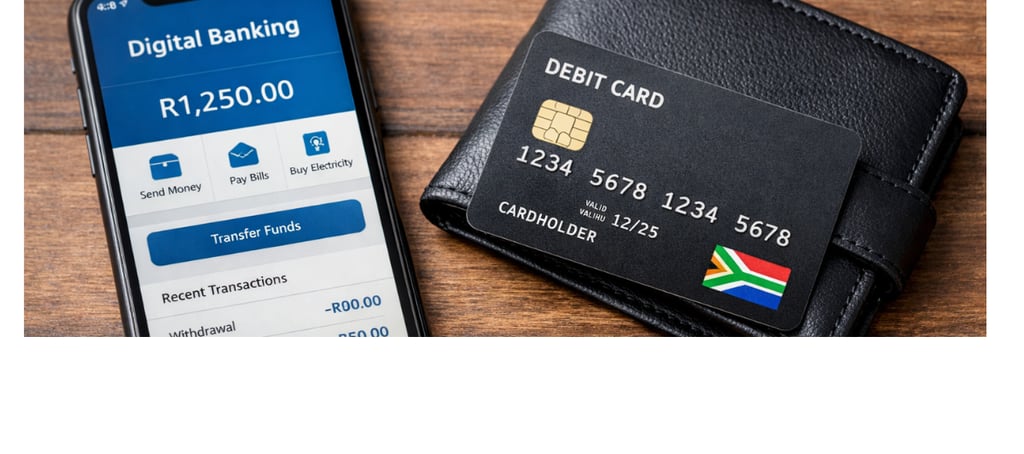
The cost of banking isn’t only the monthly fees. If you’re avoiding banks altogether to dodge charges, you’re paying a different kind of price: being cut off from the financial system, missing out on building a credit record, and making your life unnecessarily complicated. That’s expensive in ways that don’t show up on a bank statement.
So, you need a bank account; it’s just a matter of what bank account is right for you. This article follows up on our broader pieces about South African bank accounts and bank charges, but here we’re zooming in specifically on TymeBank.
Why I Opened a TymeBank Account
When TymeBank first launched, the phrase “digital banking” caught my attention. Finally, I thought, we’re moving beyond traditional banking: no branches, fast, and cheap. Maybe we’d finally get rid of physical cards altogether—something I’d always believed was overdue.
Opening the account was surprisingly easy, honestly as simple as getting a SmartShopper or Clicks Clubcard back in my student days. I signed up, and then... I forgot about it. I didn’t fully activate it; I just let it sit there.
Recently, I decided to properly activate the account and put it through its paces. I’ve collected some real insights from the experience: the activation process, card costs, actual bank charges, interactions with their call centre, and most importantly, whether this “digital” promise actually delivers.
When I hear “digital,” I think: I’m done with plastic. I don’t need a wallet. I expected a seamless “Scan to Pay” experience or easy EFTs. Instead, I found myself back on the phone with a consultant, trying to figure out why I couldn’t move my own money.
The Reality Check: My Call Centre Experience
I called their support line to sort out a few things, and I’ll give credit where it’s due: someone picked up quickly. The consultant explained that I could use a TymeCode to withdraw cash at Boxer, Pick n Pay, and TFG stores. You request it by dialing *120*543# and then withdraw at these retailers.
The charge? R10 per withdrawal. Essentially, it works like a Cash Send service.
I asked about Scan to Pay on iPhone (because I was hoping to use my phone instead of a card), and she told me that it is not currently available for iPhones. So much for going fully digital.
Then I tried to move money out via EFT. I could see the option on the app—there’s normal EFT and immediate payment—but I didn’t see the option for PayShap. She mentioned that PayShap is not available for new accounts yet due to security reasons, noting that someone could open an account in your name if they know your ID number.
This is a real security risk, but in the future, we will look at how much of a risk it actually is if someone opens a bank account in your name. I can think of a few issues, like someone applying for a loan or a credit card on your behalf, though I am not quite sure if TymeBank offers those just yet. But then again, those are separate, regulated processes with their own vetting systems.
You open a bank account to receive money or deposit funds. The biggest security risk here is money laundering—people using your name and ID to get “dirty money” into the system. In fact, one of the reasons I delayed my account opening was because I had my ID stolen along with other personal items and reported it to the South African Fraud Prevention Services (SAFPS). We will talk about this more in the future.
I couldn’t even process an immediate EFT payment because of this “new account” security risk. However, they do accept immediate payments from other banks. I also learned later that you can’t deposit large amounts when the account is new. Anti-money laundering (AML) rules are one of the cornerstones of banking, and they take them quite seriously.
The Physical Card Situation
You get your first bank card for free, which is a great benefit. But if you lose it, it’s R70 for a replacement, which is more or less in line with established traditional banks.
The Bank Charges Reality
Cash Withdrawal Options and Fees:
TymeBank offers three ways to access your cash, each with different costs: Cashback at retailer till points, ATM withdrawals, and TymeCode.
R3 flat fee: Card-based cashback at any participating retailer (Pick n Pay, Boxer, Shoprite, Checkers, SPAR, Woolworths, and Kazang merchants)—regardless of the amount withdrawn.
R10 per R1,000 (or part thereof): ATM withdrawals.
My conversation with the consultant cleared up a huge misconception I had about “free” withdrawals. She told me about the TymeCode, which functions like eWallet or Cash Send services, and noted that it carries a cost of R10. While generating the code via 120543# is free, the actual withdrawal at the till (Pick n Pay, Boxer, or TFG) costs R10.
The R3 card withdrawal fee is a flat fee. Whether you withdraw R30 or R300 at a retailer using your card, you pay that same R3. This means smaller, frequent withdrawals cost you proportionally more. Interestingly, many established banks offer this specific service free of charge.
Value-Added Services:
Electricity purchases: R3 per transaction (despite some documentation suggesting otherwise).
Data purchases: R0.50 per transaction.
Airtime purchases: R0.50 per transaction.
The Real Monthly Cost:
Based on actual fees confirmed on the app, here is what typical monthly usage looks like:
Electricity purchase (once monthly): R3
Data purchase (once monthly): R0.50
Airtime purchase (once monthly): R0.50
Card-based cash withdrawals (4 times monthly): R12
Total: R16 per month in basic transaction fees alone.
If you aren’t aware of the TymeCode costs and use ATMs to withdraw R1,000 monthly instead, you could be adding another R10–R20 to that total.
Comparison Table: TymeBank vs. 2026 “Value” Accounts
*Note: While FNB Aspire is slightly above the R100 range, it includes unlimited free transactions which might save you more in the long run if you transact frequently.
The Positives (Because There Are Some)
I have to be fair here. TymeBank's call centre experience is genuinely better than most established banks. You don't wait forever on hold, and you don't get transferred between five departments while your airtime drains away. The first consultant who answers can actually help you—even if the answer isn't what you want to hear, at least it's an answer.
Anyone who's spent 45 minutes listening to a traditional bank's hold music will appreciate this.
Better Alternatives to Consider
Look, I'm an accountant. Even a R1 difference matters to me because it's real money.
If you can manage a cheque account responsibly, several banks offer them in the R50–R100 monthly fee range. While some have income criteria, others offer student-style cheque accounts that remain accessible. I've had my ABSA cheque account since my student days, and it has served me well.
With a proper cheque account, you pay a predictable monthly fee and often get lower transaction costs. You can buy data or electricity at half the fee TymeBank charges, or get free withdrawals included. You build a relationship with a bank that can grow with you.
What does all this mean?
Is TymeBank terrible? No. Is it revolutionary digital banking? Also no.
It's easy to open and the call centre is responsive. If you rarely use banking services, the pay-as-you-go model might work. But for regular usage—buying electricity, withdrawing cash, transferring money—those small fees add up faster than you'd think.
The "digital banking" promise falls short when you can't use Scan to Pay on iPhone and still need a physical card (that costs R70 to replace). Before you switch, do the math based on your own habits. Add up what you'd pay in a typical month with TymeBank versus a traditional cheque account. You might be surprised which one actually costs you less.
Remember: being financially connected isn't just about minimizing fees. It's about access, building a history, and having tools that work when you need them. Sometimes, paying a predictable monthly fee for reliable service is the better deal.
Before you switch to a "zero-fee" bank, do the actual math. As I discussed in my piece on Stokvels and building legacies, generosity and discipline without a proper strategy is just sacrifice. Don't just fund a lifestyle by saving a few rands on monthly fees only to lose them on transactions; fund a legacy by choosing the banking tools that actually help your money grow.
Bucks Insights
Your guide to practical finance and investing.
Tips
Investing
info@bucksinsights.com
083-577-6145
© 2025. All rights reserved.