
Credit Record In South Africa: Build & Improve Your Score
Build and improve your credit record in South Africa with this complete guide. Learn about score ranges, free checks, and proven strategies for better rates.
MONEY BASICSSOUTH AFRICA GUIDETRADING AND INVESTING
1/18/202610 min read
When you hear "you have credit on your account," what comes to mind? Maybe it's:
Credit on your Vitality or Discovery account
Credit on your university student account after overpaying
Credit on your medical aid from unused benefits
Credit on your Uber Eats wallet from a refund
Credit on your prepaid electricity meter
In all these cases, "credit" simply means you have something available to you that you can use when you need it. It's not a burden—it's leverage. It's peace of mind. It's knowing that when you interact with that institution, you have options.
Financial credit works the same way. It is not inherently bad or something to fear.
It is simply financial capacity that is available to you when you need it. You do not have to use it immediately (or ever), but having it gives you flexibility, options, and leverage when dealing with financial institutions.
The key is understanding how to access it, manage it responsibly, and use it to your advantage rather than your detriment.
Your First Credit Application: Taking a Chance on Yourself
When you apply for credit for the first time, you're essentially checking to see if you already have some credit capacity in your name. If you do—great! If you don't, you're simply requesting access to a facility that should be available to you whenever you need help.
This is your birthright as a financially active citizen, not something to feel ashamed about or fear. Yet credit has been so heavily stigmatized that many people believe they're simply "not credit worthy" for formal financial services. The result? They turn to loan sharks, mashonisas, and informal lenders, paying 30%, 50%, or even 100%+ interest rates month after month—often trapping them in a cycle that is extremely difficult to escape.
It doesn't have to stay this way.
In this article, we're going to address this head-on. You can turn this around. You can build a credit profile that opens doors instead of keeping them closed. You can access affordable credit from legitimate institutions instead of predatory lenders. It starts with understanding what a credit record actually is and how to build one strategically.
What Exactly Is a Credit Record?
Your credit record is your credit behavior looking at your credit history—how you've managed credit since you started using it. It tracks the accounts you've opened (and if you've ever applied for your first credit like a phone contract, you know they often tell you to start by opening store accounts—usually more than one), how you've managed those accounts, whether payments were made on time, and whether any accounts defaulted.
An academic record works the same way: it captures your behavior over time, not just a single result. We can all agree: if you never took any subjects, you don't have much of an academic record, and it won't get you into employment. If you really want to be employable, you have to fill your academic record with subjects. That's how it becomes a record. Then comes the question of how well you did in those subjects: Distinction? Or just school leaving certificate (Higher Certificate).
Now, the one record we can all agree we want as clean as an OMO-washed white shirt—bright and spotless—is a criminal record. Your credit record? You actually want to have one (unlike a criminal record), but you also want it looking as good as possible. The challenge is that while OMO can get your shirt sparkling clean, credit bureaus don't offer a "stain remover" for your financial mistakes. Those marks stay on your record for years, fading slowly over time but never completely washing out.
This record is created and maintained by credit bureaus every time you interact with the formal credit system—opening accounts, making payments, missing payments, closing accounts. Every action leaves a mark. Every payment (or non-payment) tells a story. And lenders read this story before deciding whether to give you money and at what cost.
Credit Record vs. Credit Report: What's the Difference?
Here's where many people get confused. Let me break it down with an analogy:
Your credit report is like a school term report—it shows your performance over a recent period (typically the last 12-24 months in detail, with history going back 3-5 years depending on the bureau). When you check your credit report, you're seeing how you scored this particular term (or "semester").
Your credit record is like your complete academic transcript—it contains everything from the moment you first entered the credit system. It reflects your entire credit journey—from the first account you ever opened to your most recent behavior. It includes the mistakes you made when you were younger and less informed, as well as the improvements you made once you matured financially. It shows every account you've opened, every payment you've made (or missed), and every time someone checked your creditworthiness.
Just like employers want to see your full academic record—not just your final year results—lenders want to see your complete credit history before trusting you with money.
Why Your Credit Record Is Actually an Asset
Robert Kiyosaki's "Rich Dad Poor Dad" defines an asset as something that puts money in your pocket. By that definition, a strong credit record is absolutely an asset. Here's why:
Access to better interest rates saves you hundreds of thousands of rands over the life of a home loan. Higher credit limits give you more financial flexibility when you need it. Better insurance rates mean lower premiums (many South African insurers use credit scores to determine risk). Leverage for negotiation lets you shop around and negotiate better terms. Emergency access to capital means when life happens, you have options.
The difference between a prime interest rate and a subprime rate on a R2 million home loan can cost you over R500,000 in extra interest over 20 years. That's serious money staying in—or leaving—your pocket.
What Information Does a Credit Report Show?
In South Africa, a credit report typically reflects your behavior over the past 24 to 36 months, with some adverse information lasting longer depending on the event.
It includes:
Payment history
Credit utilization
Account age
Types of credit used
Defaults, judgments, or collections
Who Tracks Your Credit in South Africa? Where to Find Your Transcript
Three main credit bureaus maintain your credit information. You can't improve what you don't measure. Check your standing for free with these providers:
TransUnion (formerly ITC)
Experian
Compuscan
You can access your credit reports through services like:
ClearScore (free, uses Experian data)
TransUnion directly (one free report per year)
Experian directly (one free report per year)
Your credit score may differ slightly between bureaus because not all creditors report to all three. Check all of them periodically to get the full picture.
Using Your Credit Report to Your Advantage
Just like a school report, a credit report is not meant to shame you—it is meant to guide improvement.
The key question is not "Is my score good or bad?" but "Is it improving?"
If there is no improvement over time, then participation in the credit system serves no purpose.
The Credit Journey: From Zero to Hero
Stage 1: Getting Your Foot in the Door
This is often the trickiest stage. You need credit to build credit. When you're young and earning your first salary, you might be living within your means, paying cash for everything. This feels responsible, and it is, but it leaves you invisible to the credit system.
Then comes that moment: your first big-ticket purchase. Maybe it's the latest iPhone, a laptop for side hustles or for working from home, or furniture for your new place. Suddenly, cash isn't enough, and you're introduced to store accounts and credit cards, and credit becomes the bridge between desire and affordability.
Common entry points:
Clothing store accounts (Edgars, Woolworths, Mr Price)
Mobile phone contracts
Retail store cards (Makro, Game, Builders)
Starter credit cards with lower limits
Stage 2: Building Your Credit Profile
Once you have that first account, you're enrolled in what I call "the grown-up class." This is where your credit journey truly begins. You're now generating data (payment history, credit utilization, account age) that will follow you for years.
At this stage, debt often does not feel like debt. It feels like a reward for hard work.
This is also where many people overextend themselves—not out of irresponsibility, but out of limited financial education.
The smartphone trap: Many people's first serious credit commitment is a 24-month phone contract. At R800 to R1,200 per month, it seems manageable. But miss a payment, and you've just recorded your first negative mark in a system that will remember it for years.
Stage 3: Servicing Your Facilities (Doing the Homework)
This is where most people either excel or struggle. Just like in school, homework happens at home; it's your responsibility, not your creditor's. The bank doesn't care if you're disciplined. They've already given you the money.
Servicing debt is equivalent to attending classes, writing tests, and sitting for exams. You cannot skip this phase.
Your monthly payments determine whether your credit record becomes an asset or a liability.
Your monthly homework includes:
Monitor your credit utilization: Keep your credit card balances below 30% of your limit. If you have a R10,000 limit, try to keep your balance under R3,000. Lower is even better.
Pay on time, every time: Set up debit orders for at least the minimum payment a few days after payday. One late payment can drop your score by 50 to 100 points.
Automate everything: Remove the human error factor. Set up debit orders for all your credit obligations.
Keep old accounts open: The age of your credit accounts matters. That store card from 5 years ago? Keep it open even if you don't use it much. It's adding to your credit history length.
Don't apply for multiple credit products at once: Each application creates a "hard inquiry" on your report. Too many in a short period signals desperation to lenders.
Stage 4: The Big Tests (Major Credit Applications)
Eventually, you'll need credit for something significant:
A car (R200,000 to R500,000 or more)
A home loan (R1 to R3 million or more)
Business financing
Debt consolidation
This is where the real assessment happens. Your creditor will pull your full credit report and scrutinize:
Your payment history (35% of most scoring models)
Your credit utilization (30%)
Length of credit history (15%)
Credit mix (10%)
Recent credit inquiries (10%)
If you've been doing your homework, you'll pass with flying colors. If not, you might be denied or offered unfavorable terms.
Understanding Credit Score Ranges in South Africa
A credit score is a numerical summary of your credit record at a specific point in time or overall grading: just like when you are graded on your matric results—H-Higher Certificate; D-Diploma; B-Bachelors.
Most South African scoring models range up to 999, but meaningful scoring typically begins around 300.
It helps lenders quickly assess risk without reading your full report in detail.
Just like school, the score places you into broad performance bands rather than judging you on a single subject (although it contributes to the overall grading).
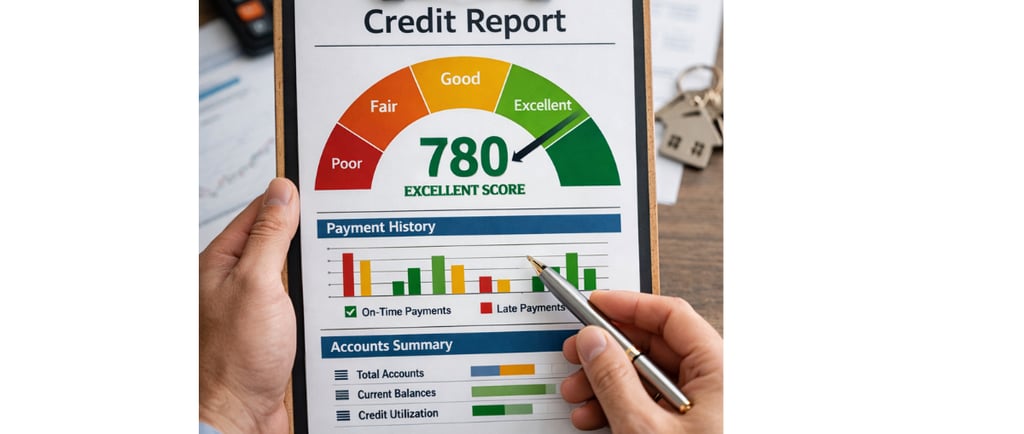
Credit scores typically range from 0 to 999 (though scoring models vary):
300 to 579: Poor. Severely limited credit access, very high interest rates
580 to 669: Fair. Limited options, higher interest rates
670 to 799: Good. Decent access to credit at reasonable rates
800 to 950+: Excellent. Best rates, highest limits, lenders compete for your busines
These score bands are broadly consistent with classifications used by leading South African credit education platforms, including Finance365 and Bizcommunity.
Think of 800+ as achieving distinction. It's not just about getting credit; it's about getting the best terms available.
Can You Improve Your Credit Score Quickly?
Yes, but it requires strategic action. Your credit report is a snapshot taken at a specific moment in time.
The Statement Date Strategy
Your credit card issuer reports your balance to credit bureaus on your statement date, not your payment due date. These are usually different dates.
Example:
Statement date: 25th of each month
Payment due date: 15th of the following month
If you have a R10,000 limit and your balance on the 25th is R8,000, that 80% utilization gets reported, even if you pay it off in full by the 15th.
Quick improvement tactics:
Pay before the statement date: If you're applying for credit soon, pay down your balances before your statement generates. Your credit report will show lower utilization.
Request credit limit increases: This immediately lowers your utilization ratio. If you have R5,000 debt on a R10,000 limit (50% utilization), increasing your limit to R15,000 drops you to 33% utilization without paying a cent.
Become an authorized user: If a family member with excellent credit adds you as an authorized user on their old, well-managed account, it can boost your score. This is less common in South Africa than in the US and depends heavily on the lender's reporting practices.
Dispute errors: Check your report for mistakes. Accounts that aren't yours? Payments marked late that you paid on time? Dispute them immediately.
Pay collections and settle judgments: While these negative marks stay on your report, showing them as "paid" is better than "outstanding."
The 90-Day Improvement Plan
If you have 3 months before a major credit application:
Month 1:
Pull all three credit reports
Dispute any errors
Pay all current accounts on time
Identify your highest utilization accounts
Month 2:
Pay down high-utilization accounts below 30%
Request credit limit increases on good-standing accounts
Continue perfect payment history
Don't apply for new credit
Month 3:
Pay down revolving credit to below 10% utilization
Make payments before statement dates
Ensure all debit orders are funded
Check reports again to verify improvements
Common Mistakes That Damage Your Credit
Closing old accounts: Reduces your available credit and shortens your credit history
Only paying minimums long-term: Keeps utilization high and costs you a fortune in interest
Ignoring small debts: A R500 municipal bill in collections hurts as much as R50,000
Co-signing loans carelessly: You're equally responsible if the primary borrower defaults
Not checking your report: You can't fix what you don't monitor
The Long Game: Building Wealth Through Credit
Your credit record isn't just about getting loans; it's about building wealth efficiently. With excellent credit, you pay less interest, keeping more money for investing. You can leverage low-interest debt for assets that appreciate (property). You have emergency liquidity without liquidating investments. You can negotiate from a position of strength.
Think of it this way: two people buy identical R2 million homes. One has excellent credit (prime rate, 11.75%), the other has poor credit (prime + 5%, 16.75%). Over 20 years, the person with poor credit pays R1.2 million more in interest. That's R1.2 million that could have gone toward retirement, children's education, or building generational wealth.
Credit is a Life Skill
Managing credit isn't taught in schools, yet it's one of the most important financial skills you'll ever need. Your credit record tells a story about you—your reliability, your discipline, your ability to honor commitments.
The good news? Unlike your actual school record, you can always improve your credit record. Every month is a fresh opportunity to demonstrate responsibility. Every on-time payment adds a positive line to your story. Every smart credit decision compounds into long-term financial freedom.
Start where you are. Check your credit report today. Make a plan. Do your homework. And remember: you're not building credit for its own sake—you're building a tool that will help you achieve your financial goals and dreams. Learn more strategies to pay your debt faster.
Action Steps:
Sign up for ClearScore (free) and check your credit report this week
Set up debit orders for all credit obligations
Calculate your credit utilization and make a plan to get below 30%
Set a calendar reminder to check your report quarterly
Review your financial goals and understand how credit can help (or hinder) achieving them
Your financial future is being written right now, one payment at a time. Make sure it reflects the life you are trying to build.
Bucks Insights
Your guide to practical finance and investing.
Tips
Investing
info@bucksinsights.com
083-577-6145
© 2025. All rights reserved.