
Savings And Investment Vehicle Types In South Africa: Part 1
Discover the best savings and investment vehicle types in South Africa. Compare Bank Savings, Fixed Deposits, Money Markets, Stock Market, Unit Trusts, and Bonds to grow your wealth.
TRADING AND INVESTINGSOUTH AFRICA GUIDE
2/19/202614 min read
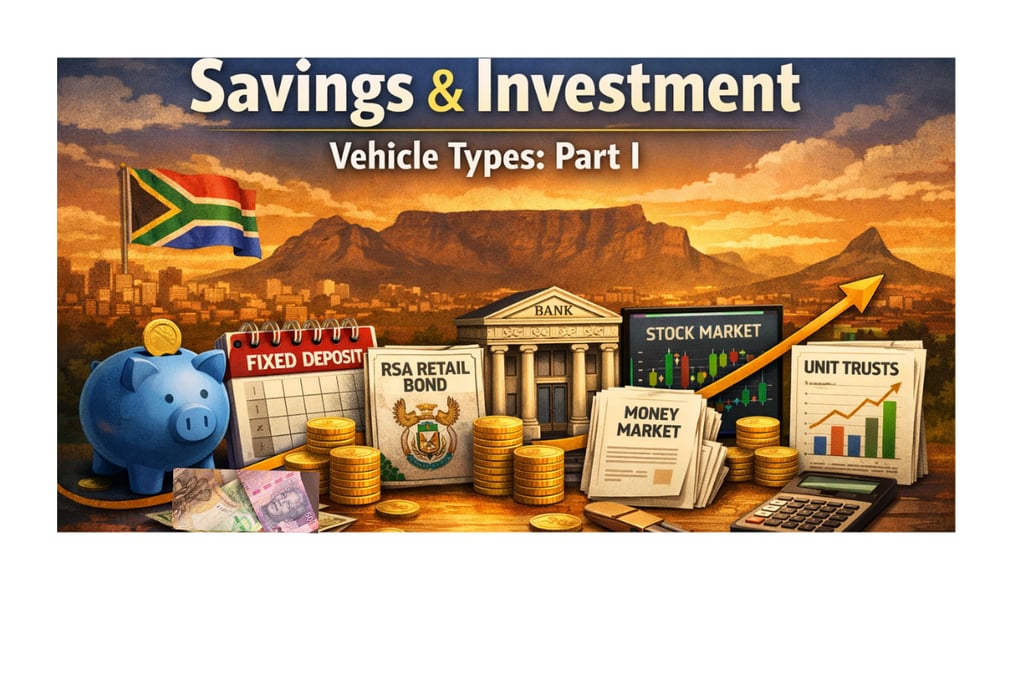
When I started this article, I didn't see how much work it would require and how big it could get. Now after working at it, I've decided to split this into three parts. This is the first part, and we will release parts two and three in future.
We have talked about growing wealth through investing, and the differences between trading and investing. I must admit, though, in those articles we leaned more towards being actively involved in the financial markets. What if you are someone who has the will and the financial resources, but not quite the time to actively monitor the market's movements?
We are going to look at the options available to you — options that don't necessarily require you to constantly keep an eye on your investments. Instead, you outsource this responsibility, and the associated risk, to someone else.
Outsourcing that risk comes at a cost. But so does doing it yourself — and that cost can be quite significant, to the point of losing all of your money. So, if there are options that promise a return with little to no cost, we should understand them properly.
Everything is viewed in the context of risk versus benefit (the "return" in the investment world) associated with each type of savings or investment vehicle.
First off, let's get the key definitions out of the way.
Definitions
Capital: This is the amount of money you have, or are willing to put down for investment, right now.
Interest Rate: We covered different types of interest rates in our article about the Repo Rate. However, when we were looking at the interest rate under the repo rate, we were more focusing on the interest rate charged on the debts owed to the bank through credit cards, personal loans, home loans, and vehicle finance.
So we looked at it as a cost. In this section, the investing section, the interest rate is what the bank promises to pay in exchange for you saving money with them.
This is very different from the interest rate you pay on your credit card or personal loan.
Required Rate of Return / Rate of Return: This is the return you as an investor would expect from an investment after accounting for the risk that comes with it.
The higher the risk, the higher the return required to compensate for that level of risk. It's basically what the investment gives back to you on top of the capital you put down today.
It's calculated as a percentage. For example: you have R100 to invest (capital), and I promise to give you R110 back at the end of the year. You've earned R10 as a return — a 10% return on R100 invested.
That return can come in the form of interest income — if the arrangement was that you lent me money — or it could be called a gain or capital appreciation, if the arrangement was that you invested in a company or project. These are also taxed differently.
For simplicity, these are expressed as an annual percentage across the board, which makes them easy to compare. It's like looking at PnP seedless grapes for R50 versus the same grapes at Checkers for R45. You might choose Checkers because it's cheaper, or you might still go with PnP because you earn Smart Shopper points and genuinely love the brand.
Same thing in the savings and investment world. You can scan down a list and compare a 5% return from the bank versus a 7% return from a government bond.
This transparency is what Bucks Insights is striving for — because, as we discussed in our Bank Accounts article, some people still open accounts based on what their parents used, without asking whether their needs are even the same.
Risk-Free Rate: This is the annual rate of return on government bonds.
It is the minimum rate of return that any investment is generally expected to beat. Since the government has the power to tax and print money, they are the least likely to default.
This rate is the "floor" — any other investment should ideally return more than this to justify the extra risk.
We are going to discuss the options available to grow your money, starting from the lowest risk and lowest return, all the way to the highest risk and highest potential return.
I have decided to include bank savings accounts in this list because, even though they aren't traditional investment vehicles, they are the most accessible starting point — no complicated onboarding, no minimums beyond what the bank requires, no stress.
The actual investment vehicles have simplified significantly over the years, but they still aren't as seamless as opening a savings account.
Here is our list for Part I:
Bank Savings Accounts
Fixed Deposits
Bond Market
Money Market
Stock Market
Unit Trusts
Parts II and III will cover ETFs, Commodities, Cryptocurrency, Hedge Funds, and Property.
Bank Savings Account
This is where you open a savings account with your bank, deposit money into it — either as a lump sum or a recurring fixed monthly deposit — and the bank pays you interest in return for keeping your money with them.
The interest rate you earn is generally lower than the prime lending rate (which we covered in our Repo Rate article).
It typically sits around the repo rate or below — historically somewhere in the 4% to 6.5% range, depending on the bank and the type of account.
What happens behind the scenes is that the bank takes your money and lends it out — through personal loans, credit cards, home loans — at a rate calculated around prime, and pockets the difference. That spread is their profit.
To put numbers to it: credit card interest rates in South Africa currently sit around 20% per annum, while a typical savings account might earn you around 5% to 6.5%.
So if you have a savings account earning 5.5% and a credit card charging you 20%, you are effectively giving away about 14.5% in the form of interest you don't need to be paying. That's not a savings strategy — that's a leak.
On top of that, some of these accounts lock your funds in for a notice period — 32 days, 60 days, sometimes more. So if you urgently need your money, you face a difficult decision: break the notice period and take the penalty, or find another way.
The loan shark option is technically off the books, as it’s not showing on your bank statement, but it comes at about ten times the cost — so that's firmly in the "not recommended" category.
And yet — there is something psychologically satisfying about watching that positive savings balance on your banking app, and seeing your monthly statement reflect interest earned. It feels good. Until you look at the full picture and realise you're losing money on the other side.
It's even more pronounced when you're carrying a personal loan, which typically charges anywhere from 18% to 29.25% per annum depending on your credit profile and the lender. If you're doing that while also maintaining a savings account earning 5%, it starts to look a lot like the Stokvel effect — putting money in one pocket while pulling it out of another.
So if you have both a credit card or personal loan and a savings account running at the same time, the numbers don't quite add up.
But beyond the math, it is still a great tool for forcing yourself to save. For many of us, discipline doesn't come naturally, and a savings account with a notice period is a built-in friction that makes it harder to spend impulsively. As a country, we're not very good at saving — South Africa has consistently run a fiscal deficit, meaning we collectively spend more than we earn.
So if the savings account is what keeps you from spending everything, it's doing its job.
What do you get as a return? Interest that is compounded (added) onto the capital you have deposited, typically calculated daily and added to your account monthly.
When do you get the return? Monthly.
Pros
Very accessible and easy to open
Forces savings discipline
Interest income is tax-exempt up to R23,800 per year if you are under 65, and up to R34,500 if you are 65 or older. If you have a formal Tax-Free Savings Account (TFSA), you can invest up to R36,000 per year (lifetime limit of R500,000) and pay zero tax on any interest, dividends, or capital gains earned within it.
Cons
Small return compared to most other options we'll discuss
Counterproductive if you're carrying high-interest debt at the same time
Fixed Deposit
Think of this as the more committed, better-paid version of a savings account. With a fixed deposit, you agree to lock your money away with the bank for a fixed period — typically anywhere from one month to five years — and in exchange, the bank rewards you with a higher, guaranteed interest rate for the full term.
The key word here is fixed. Unlike a savings account where the rate can move with market conditions, the rate on a fixed deposit is locked in from day one.
If you agree on 8% for 12 months, you earn 8% for those 12 months — regardless of what the Reserve Bank does with interest rates in between.
This cuts both ways: if rates rise during your term, you're stuck at your agreed rate; but if rates fall, you're still earning what you signed up for.
Banks offer fixed deposits because it benefits them too — knowing your money is going nowhere for a set period allows them to plan their lending activities more confidently. They pass some of that benefit on to you in the form of a better rate.
The trade-off is liquidity. Once you've placed a fixed deposit, that money is generally not accessible until the term ends. Some banks allow early withdrawal, but it almost always comes with a penalty — usually a reduction in the interest earned.
So before you commit, the honest question to ask yourself is: will I need this money before the term is up?
Fixed deposits are particularly useful for money you know you won't need for a while — a year-end bonus, an inheritance, proceeds from a sale — where you want a guaranteed return without having to think about it or monitor anything.
What do you get as a return? A fixed interest rate agreed upfront, capitalised monthly and paid out either monthly, at the end of the term, or rolled over into a new fixed deposit — depending on the arrangement you choose.
When do you get the return? Monthly (if you elect to receive interest payouts), or at maturity (end of the term) if you prefer the interest to compound over the full period. Compounding it to maturity typically gives you a slightly better overall return.
Pros
Guaranteed, fixed return — no surprises
Better rate than a standard savings account
Simple and low effort — you set it and forget it
Available at all major banks with relatively low minimums
Cons
Your money is locked in — early withdrawal usually attracts a penalty
If interest rates rise significantly during your term, you miss out on the upside
Returns are still modest compared to the investment vehicles further down this list
Bond Market
This is where you get a chance to be on the other side of the equation. Instead of being the saver — the one earning a small return while the bank is earning at least three times as much as they are giving you — you become the creditor. And being a creditor pays better than being a saver. Ask a mashonisa; they know this very well. But unlike being a mashonisa, there is a structured, legally protected return here, and you're not chasing anyone down for your money.
The most accessible version of this for ordinary South Africans is the RSA Retail Savings Bond — a direct investment with the South African government.
You lend the government your money, they promise to pay you a fixed interest rate and return your capital at the end of the term.
These are considered the safest investment vehicles available, because the risk of the South African government defaulting on bonds issued in its own currency is extremely low. As a country, we're still paying social grants. The government isn't going to miss your coupon payment before it misses that.
Because of this near-zero risk of default, the rate these bonds pay is referred to as the risk-free rate — the baseline that any investment is generally expected to beat. The "Floor" as we referred to it when we discussed the risk-free rate above.
If an investment can't outperform government bonds, why take on the extra risk?
RSA Retail Savings Bonds are available in fixed-rate terms of 2, 3, and 5 years, and in inflation-linked options for 3, 5, or 10 years.
As of mid-2025, the fixed-rate bonds were offering around 8.5% for a 3-year term and up to around 9.25% for a 5-year term — significantly better than a standard bank savings account.
The minimum investment is R1,000, and you can apply directly through the RSA Retail Savings Bonds website or at a Post Office branch, with no fees or commission charged.
There are also bonds issued by large private companies and state-owned entities like Eskom or Transnet. These typically offer slightly higher rates than government bonds to compensate for the marginally higher risk of default — but they are generally still considered conservative investments.
However, these institutional bonds, are not as easily accessible to retail investors (you and I); they tend to require significantly larger minimum investments and are usually traded through brokers or wealth management platforms.
Now, I'm thinking about my grandfather. My mother used to talk about how, after he retired, he fixed his pension somewhere and lived off the interest paid to him every month — locking the lump sum he received when he retired into a fixed rate and collecting payments like clockwork, until he had the clarity to do something bigger with the capital. Which he did. That's how he eventually bought a tractor and became his own boss.
As a child, hearing this story, it sounded too good to be true. It sounded like the only real option available to someone who had been blessed enough to have worked for that long, and been rewarded with his hard-earned money.
Now I know what they were referring to was the fixed deposit, as we discussed above. But now I wonder whether he had been well-advised to put his savings into something like these government bonds instead
What do you get as a return? A fixed coupon — a predetermined interest amount paid to you at regular intervals.
On RSA Retail Savings Bonds, coupons are paid semi-annually (31 March and 30 September), though you can also opt for monthly payments.
At the end of the term, your original capital is returned in full.
For simplicity, we are going to stop here for now. We are not going to discuss the secondary market where you are able to sell your bonds before maturity, and bond yields. We will discuss this in detail in future when we release an article that covers bonds specifically.
When do you get the return? Semi-annually (or monthly if you elect that option).
Pros
Relatively safe compared to most other options
Meaningfully better return than a bank savings account
No fees or commissions on RSA Retail Savings Bonds
You can still receive interest income while your capital is locked away
Cons
Your capital is committed for at least 2 years (with early withdrawal possible after 12 months, subject to a penalty)
Not as liquid as a savings account — not ideal if you might need the money suddenly
Money Market
The money market works similarly to the bond market. The same concept applies — you're lending money to earn interest — but the time horizons are much shorter.
Money market instruments typically have a maximum term of 12 months (by regulation, underlying assets cannot be invested for more than one year), and the average maturity of the assets in a money market fund cannot exceed 90 days.
In practice, money market funds are highly liquid — some allow you to access your money within a day or two. This makes them popular as a parking place for cash you might need relatively soon, or for people who aren't yet ready to commit to a longer-term investment.
When you invest in a money market fund, your money is pooled with other investors' money and placed by professional fund managers into a range of short-term instruments — bank deposits, treasury bills, and similar instruments.
Because fund managers operate at institutional level, they often access better rates than you would get by walking into a branch yourself.
The return you earn on a money market fund is not fixed — it moves with short-term interest rates, which are influenced by the repo rate. When the Reserve Bank cuts rates, money market yields come down, and vice versa.
Currently, South African money market funds have been yielding in the region of 8% to 9% per annum, which comfortably beats most savings accounts while still providing strong liquidity.
One thing worth noting: unlike a savings account or a government bond, your capital in a money market fund is not technically guaranteed. It is very unlikely to decrease — money market funds are designed to preserve capital — but if an institution that the fund has lent to defaults, there is a small possibility of loss. In practice, this is exceedingly rare.
What do you get as a return? An interest-like return that fluctuates in line with prevailing short-term interest rates (linked with the repo rate).
Typically slightly better than a bank savings account, with minimal risk.
When do you get the return? Returns are typically accrued daily and paid out monthly, or reinvested depending on how the fund is structured.
Pros
Very liquid — you can usually access your money quickly
Better return than a normal bank savings account
Professionally managed; no expertise required from your side
Low minimum investments (some funds start from as little as R500)
Cons
Returns are not fixed — they move with interest rates, so they can decrease
Capital is not formally guaranteed (though the risk of loss is very low)
Lower long-term return potential compared to equities or bonds
Stock Market
We have already covered the stock market in detail in our investing versus trading article.
Investing in the stock market is essentially about investing directly in companies by buying their shares on the stock exchange.
What do you get as a return? This one is trickier than everything we've discussed so far.
There is zero guarantee of a return. You can lose everything — but if you get it right, you can win big. That is the risk-return relationship in action. A company's share price could move 30% or more in a year.
By accepting that level of risk compared to, say, locking your money in a government bond for two years, you are being compensated with the possibility of a much higher return.
You may also receive dividends — a share of the company's profits paid back to you as a shareholder.
But dividends are not guaranteed. Companies are not required to pay them. Tesla has never paid a dividend. Investors in Tesla were investing purely on the belief that the share price would grow — what's called capital appreciation.
When you eventually sell your shares, the difference between what you paid and what you sell for is your return.
When do you get the return? Whenever you decide to sell your shares.
Pros
High flexibility and liquidity — you can sell at almost any time during market hours
Potential for significantly higher returns than bonds or savings accounts over the long term
Cons
High risk — no guaranteed return, and losses are possible
Requires time, knowledge, and emotional discipline to do well
Unit Trusts
This is where things get interesting for the person who believes the stock market holds the best long-term returns, but honestly has no time — or interest — in learning which companies to invest in. That's a completely valid position. And it's exactly where Unit Trusts come in.
Here's how it works: professional fund managers put together a basket of different assets — think of it like you are planning a seafood Sunday lunch — you go to the shop to buy the ingredients for this particular lunch.
When someone looks at your basket, it tells a story. They can see what you're cooking. A Unit Trust basket works the same way. Fund managers assemble a collection of investments with a specific purpose and strategy in mind (like a seafood Sunday lunch).
For example, a "dividend income" fund would hold a basket of companies known for paying consistent, high dividends.
A "balanced fund" might hold a mix of equities, bonds, and money market instruments.
There are growth funds, income funds, offshore funds — a wide variety.
You then buy into this basket by purchasing units — shares of the fund. Remember the concept of units from our Stokvel article? Same idea here.
When more people invest, more units are issued. When people withdraw, units are redeemed. The price of each unit reflects the value of the underlying assets in the fund.
The fund manager's job — and the fee you pay for that service — is to actively manage the basket. They research companies, monitor markets, and make decisions on your behalf. You're outsourcing the work and, to some extent, the risk of poor stock selection, to someone who does this for a living.
Unit trusts are regulated by the Financial Sector Conduct Authority (FSCA) and must operate within strict rules about what they can and cannot invest in. This provides an important layer of investor protection. That's why they are called regulated funds.
What do you get as a return? It depends on the type of unit trust.
Some pay out income distributions (similar to dividends) at regular intervals.
Others are focused on capital growth — the value of your units increases over time.
Many funds offer a combination of both.
When do you get the return? Income distributions are typically paid quarterly or annually, depending on the fund. Capital growth is realised when you sell your units.
Pros
Access to a professionally managed, diversified portfolio
No need to research individual companies or monitor markets daily
Regulated and structured — strong investor protection
Wide variety of fund types to match your goals and risk appetite
Accessible entry points — many funds allow monthly debit orders from as little as R500
Cons
You pay management fees (expressed as a Total Expense Ratio, or TER) — these eat into your returns, so it's important to compare costs across funds
You give up control — the fund manager makes the investment decisions, not you
Returns are not guaranteed — poor fund management or bad market conditions can still result in losses
Did You Know? In South Africa, these are officially called Collective Investment Schemes (CIS). While the first SA fund (Sage Fund) launched in 1965, the concept actually started in the UK in 1931. The term "Collective" is used because it literally means a group of people pooling their resources. Same concept we discussed in our Stokvel article.
Part II will cover ETFs, Private Debt (Private Credit) and Commodities. Part III will cover Cryptocurrency, Hedge Funds, and Property. Watch this space.
Bucks Insights
Your guide to practical finance and investing.
Tips
Investing
info@bucksinsights.com
083-577-6145
© 2025. All rights reserved.