
Interest Rates South Africa 2026: Repo Rate Explained
Learn how SARB's repo rate affects your debt. Understand the interest rates South Africa: prime lending rates, home loans & credit cards in South Africa. Updated January 2026.
MONEY BASICSSOUTH AFRICA GUIDETRADING AND INVESTING
1/11/20266 min read
What Actually Is an Interest Rate?
Think of interest as the cost of borrowing someone else's money. When you take out a loan, you're not just paying back what you borrowed—you're paying a fee for the privilege of using that money. This fee is the interest rate, expressed as a percentage.
Here's the part that stings: in the early years of repaying debt (especially mortgages), the majority of your monthly payment goes toward interest, not the actual amount you borrowed. You're paying the bank first, your debt second.
How Banks Get Their Money (And Why It Matters to You)
To understand why you're charged what you're charged, you need to understand how the banking system works.
The South African Reserve Bank (SARB): The Banks' Bank (Big Boss)
Banks don't create money out of thin air (despite what it might feel like). They borrow it—from the South African Reserve Bank. Yes, even banks need loans.
To understand why your debt fluctuates, you have to understand the food chain. Think of the Reserve Bank as the "wholesaler" of money. These are the guys that have the ability to print money—all the money we have in the country was created by them. Imagine a big cabbage farm given autonomy to be the only farm in the country that produces cabbage, and all the retailers (Checkers, Pick n Pay, Woolworths, etc.) are buying the cabbage from this big cabbage farm (SARB) in order to onsell it to customers like you and me.
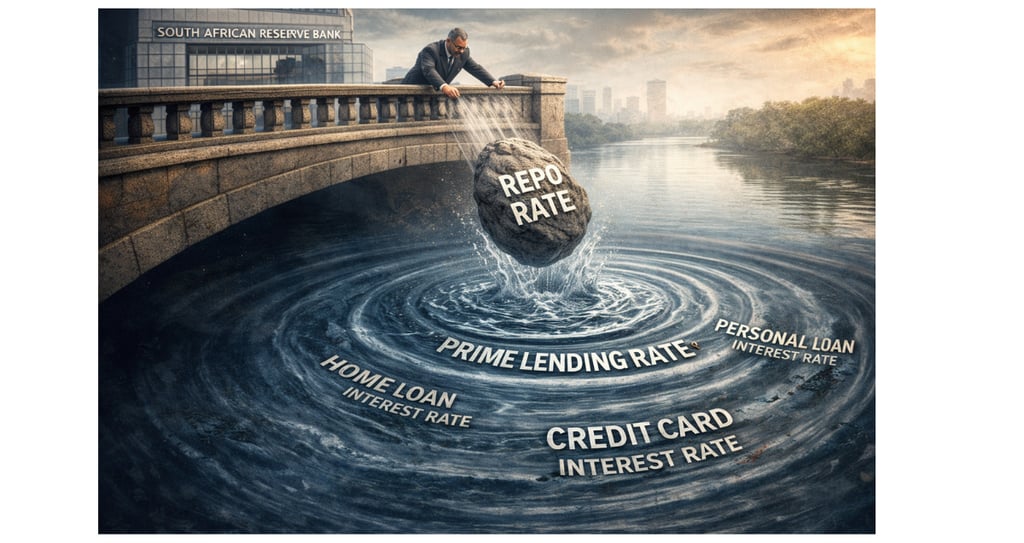
If you wanted to open your own bank today, you would eventually need to "buy" money from the Reserve Bank so you could "sell" it (lend it) to customers. The price the Reserve Bank charges all retail banks (like Standard Bank, FNB, or Capitec) is called the Repo Rate.
The repo rate is the lowest interest rate allowed in the country—or stated differently, it's the base cost or minimum cost of borrowing money in the country. This is determined by the Big Boss (SARB). This is the interest rate the South African Reserve Bank charges commercial banks when they borrow money. At the time of writing this article, the repo rate is 6.75%.
When the Reserve Bank adjusts the repo rate, every other interest rate in the economy is adjusted accordingly. This includes interest rates on:
Credit cards
Personal loans
Vehicle finance
Home loans
Savings accounts
The Reserve Bank adjusts this rate based on two main factors:
The current economic health of South Africa
Inflation (which we'll explain in a moment)
These decisions are made approximately two months in advance, giving the Reserve Bank time to forecast where the economy is heading.
From Repo Rate to Prime Lending Rate
The Prime Lending Rate: What You're Actually Charged
Banks are businesses. Their primary business is lending money at a profit.
They can't charge you the same rate they're paying (that would be charity, not banking). So they add a fixed spread on top of the repo rate. In South Africa, this spread is locked at 3.5%.
This gives us the prime lending rate—the base rate banks charge their most creditworthy customers.
Calculation: Repo Rate (6.75%) + Fixed Spread (3.5%) = Prime Lending Rate (10.25%)
But here's where it gets interesting for you personally.
"Prime Plus 3" or "Prime Minus 1"—What Does It Mean?
You've probably heard these terms when applying for a loan. They're describing your interest rate relative to the prime lending rate. They are pricing your loan relative to the prime rate.
Prime +3: You're paying 10.25% + 3% = 13.25%
Prime -1: You're paying 10.25% - 1% = 9.25%
How do you know if you've got a good deal?
The closer you are to prime (or better yet, below it), the better your deal. Banks offer rates below prime to customers with excellent credit scores, stable income, and low debt levels. If you're being quoted "prime plus 5" or higher, it's a signal that:
The bank sees you as high-risk, OR
You haven't shopped around enough
Home loans typically range from prime to prime +2%. Personal loans and credit cards? They can go much higher—sometimes prime +10% or more.
Your rate that the bank quotes you depends on:
Credit profile
Income stability
Risk to the bank
Negotiation at the time of signing
Many people never negotiate — and that costs them hundreds of thousands of rands over time.
Inflation: The Invisible Force Behind Interest Rate Changes
The Reserve Bank does not adjust interest rates randomly. Its primary mandate is to control inflation.
Inflation is the increase in the cost of living over time. In South Africa, it's measured by the Consumer Price Index (CPI)—essentially tracking how much a typical basket of goods costs.
This basket includes items like:
Bread, milk, and meat
Fuel
Electricity
Rent
Clothing
Transportation
When this basket costs more this year than last year, that's inflation. When a cow that cost R10,000 five years ago now costs R18,000, you're seeing inflation in action.
Inflation is also one of the main reasons why investing is not optional but necessary — something we explore in more detail in our Investment Fundamentals guide.
Current inflation rate (at time of writing): 3.6%
The Reserve Bank has set an inflation target of 3%, with a tolerance of 1 percentage point on either side (meaning 2-4% is acceptable). When inflation threatens to break through that 4% ceiling—or drop below 2%—the Reserve Bank steps in by adjusting the repo rate.
How Interest Rates Control Inflation
When inflation is too high (above 4%): The Reserve Bank raises the repo rate. This makes borrowing more expensive, which means people and businesses spend less money. When spending decreases, demand drops, and prices stabilize or fall.
When inflation is too low (below 2%): The Reserve Bank lowers the repo rate. This makes borrowing cheaper, encouraging people to spend and businesses to invest. Increased spending drives demand, which pushes prices back up.
It's a delicate balancing act.
Another way to think about it: when you're getting punished by rising prices, the Reserve Bank comes and punishes you for the second time by raising interest rates. Now you're paying more on both sides. And when you're rewarded because prices are low and you get to buy more with the same amount of money, it's Christmas—and Santa (SARB) comes along cutting the interest rates. Now you're paying less on both sides.
When Does the Reserve Bank Announce Rate Changes?
The Reserve Bank announces interest rate decisions on the last Thursday of every second month, starting in January:
January
March
May
July
September
November
These announcements send ripples through every corner of the economy. These announcements directly affect your monthly repayments—sometimes immediately.
Who Wins and Who Loses When Rates Change?
When Interest Rates Go UP:
Losers:
Anyone with credit card debt (your minimum payment increases)
Personal loan holders (installments rise)
Mortgage bond holders (your monthly payment jumps)
Businesses looking to borrow for expansion
Vehicle finance holders
Winners:
Savers with interest-earning accounts (you earn more on your deposits)
Bond investors (bond values typically increase)
Retirees living off interest income
When Interest Rates Go DOWN:
Simply reverse the above. Borrowers celebrate, savers grimace.
If you’re on the losing side of rising interest rates, the fastest way to regain control is to reduce how much interest you’re exposed to — here’s a practical guide on how to pay off debt faster in South Africa.
The Terminology You Need to Know
You've likely encountered interest in informal settings—stokvels that loan money to members with interest, or unfortunately, loan sharks who charge unregulated rates. These operate on the same principle as banks, but without regulatory oversight or consumer protection.
In the formal financial services sector, everything is regulated. Understanding these regulations is how you access better money at better rates—and ultimately, how you build real wealth instead of just servicing debt.
Key terms to remember:
Repo Rate: What banks pay the Reserve Bank (currently 6.75%)
Prime Lending Rate: The base rate for consumers (currently 10.25%)
Cost of Capital: Another term for interest—what you pay to use someone else's money
If inflation is quietly eroding your purchasing power, understanding how investments work is the next step — start with our Investment Fundamentals article.
The Bottom Line
Interest rates aren't some mysterious force—they're a deliberate economic tool. The Reserve Bank pulls the repo rate lever to keep inflation in check. Banks add their margin on top. And you? You're left paying the final number.
Understanding this system doesn't just make you more financially literate—it gives you power. Power to negotiate better rates. Power to know when to borrow and when to save. Power to recognize when you're being taken advantage of.
Because that number you rush to sign? It determines whether you build wealth or finance someone else's.
Bucks Insights
Your guide to practical finance and investing.
Tips
Investing
info@bucksinsights.com
083-577-6145
© 2025. All rights reserved.