
Trading vs Investing: Key Differences, Risks & Long-Term Trade-Offs
Trading vs investing; Trading and investing are often confused, yet they differ in risk, time horizon, and strategy. Learn the key trade-offs to choose the approach that fits your financial goals.
TRADING AND INVESTING
1/25/202613 min read
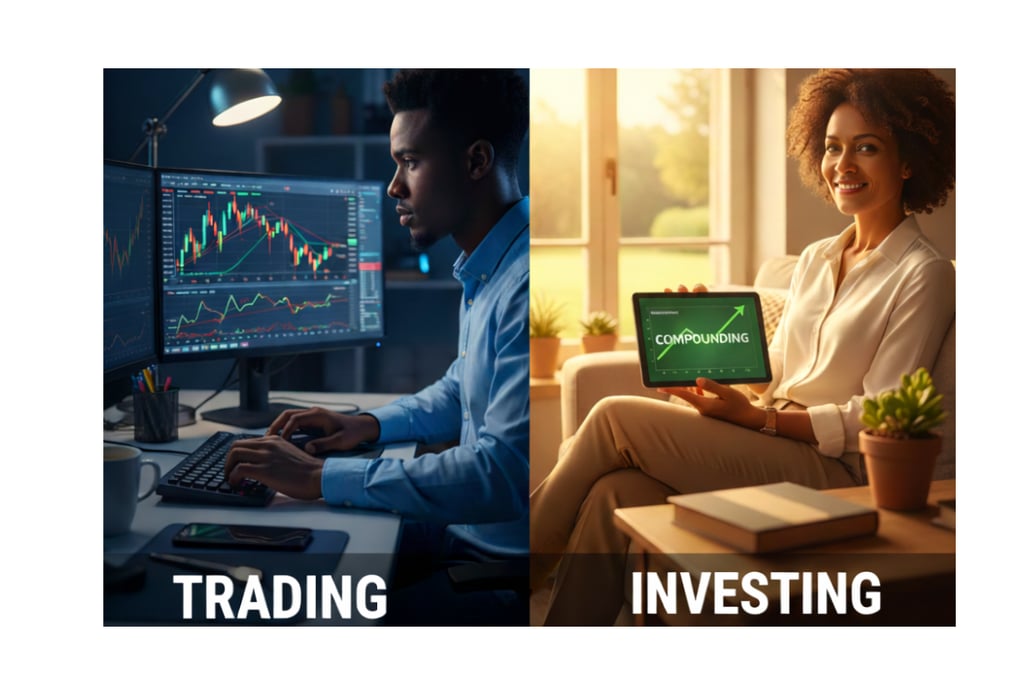
In the world of financial markets, two fundamental approaches dominate: trading and investing. While they may seem similar on the surface—both involve buying securities with the goal of generating returns—they differ significantly in strategy, time horizon, risk profile, and the skills required to succeed.
In this article, we unpack the differences between trading and investing, explore their respective risks and rewards, and help you understand which approach may be more suitable for your goals, temperament, and financial situation. The aim is not to promote one over the other, but to equip you with enough context to make an informed decision.
Whether you're a complete beginner or someone looking to refine your approach, understanding these distinctions is essential for making informed financial decisions.
In a nutshell, the main difference is time and frequency.
The Core Difference: Time Horizon
At its most basic level, the primary difference between trading and investing is the time horizon—how long you hold a security before selling it.
Trading is a short-term strategy. Traders buy and sell securities frequently, sometimes within minutes, hours, days, or weeks. The goal is to capitalize on short-term price movements and market volatility. Traders are essentially betting on where prices will move in the near future.
Investing, on the other hand, is a long-term strategy. Investors purchase securities with the intention of holding them for months, years, or even decades. The focus is on the fundamental value of the asset and its potential to grow over time, rather than short-term price fluctuations.
The Cattle Farm Analogy
Imagine you go to a cattle farm and purchase ten cows. If your intention is to transport them to your farm and immediately resell them at a profit without keeping them, that's trading. You're looking for a quick turnaround and a small margin per cow.
This is similar to informal street vendors who buy snacks, sweets, or fruits from wholesalers and resell them on the streets or from their homes, making a small profit on each item sold. These are "traders" in the truest sense—they're moving inventory quickly for incremental gains. In financial markets, the principle is the same, just with higher stakes, higher risks, and potentially higher rewards.
Now, imagine instead that you buy two cows with the intention of raising them long-term. Over time, these cows multiply, giving birth to more cows. You build a herd, and you might sell some along the way to generate cash for other investments—a process called diversification. This is investing. You're focused on long-term growth and building wealth gradually.
Understanding Key Concepts
What is a Security?
In the financial world, a security is a tradeable financial instrument that you receive in exchange for your money. Think of it like the share definition we covered in our Investment Fundamentals article, where we explained that a share is basically an individual's portion of the whole company.
The terms "security," "financial instrument," and "instrument" are used interchangeably in financial markets. We use these terms to refer to anything you can trade or invest in, including:
Equities (stocks/shares)
Bonds
Commodities (gold, oil, agricultural products, etc.)
Cryptocurrencies
Mutual funds
Exchange-traded funds (ETFs)
Options and derivatives
A security represents either ownership in something (like stocks/equities, where you own a piece of a company) or a debt that's owed to you (like bonds, where you've essentially loaned money to a government or corporation).
Think of the cow in our example as a security. It's a tangible asset that has value, and you can exchange it for cash whenever you choose. Similarly, when you buy a stock, bond, or any other financial instrument, you're acquiring something of value that you can later sell. However, unlike cash sitting in a savings account, the value of a security is not guaranteed—it can fluctuate based on market conditions, company performance, economic factors, and investor sentiment.
The key characteristic of securities is that they can be converted back to cash, making them liquid assets. They have the potential to grow in value over time (capital appreciation), and some securities like dividend-paying stocks or bonds also provide regular income. However, they also carry the risk of losing value.
What is Opportunity Cost?
Opportunity cost is the value of what you give up when you choose one option over another. Every financial decision involves trade-offs, and understanding opportunity cost helps you evaluate whether you're making the best choice.
For example, if you have R10,000 and choose to invest it in a stock rather than putting it in a savings account, the opportunity cost is the guaranteed interest you would have earned from the savings account. Conversely, if you choose the savings account, the opportunity cost is the potential higher returns you might have earned from the stock investment.
In the context of trading vs. investing:
Trading opportunity cost: The potential long-term gains you miss by taking quick profits
Investing opportunity cost: The short-term profits you could have captured through active trading
Traders thrive on noise. They try to predict the impact of news (like inflation data) on the price.
Investors ignore the noise. They wait for the market to "smooth out" over years.
Consider Sasol in 2020. When the share price crashed to an all-time low of R20.77 on March 23, 2020—driven by COVID-19 lockdowns, collapsing oil prices, and concerns about the company's debt—a day trader might have seen their value wiped out and been forced to close their position at a loss. A long-term investor, however, simply ignored the "noise" and waited for the recovery. Today, with Sasol trading at R117.03, that represents a recovery of approximately 464% from the crash bottom. The patient investor who held through the volatility was rewarded, while the trader who panicked during the downturn locked in their losses.
Your job is to evaluate which option offers better risk-adjusted returns based on your goals, skills, and risk tolerance.
Trading: The Short-Term Approach
How Trading Works
When you trade, you're betting on short-term price movements. You have a specific amount of money you're willing to risk on each trade, and you're trying to profit from volatility—the up-and-down swings in price that occur over short periods.
Market Noise and Price Movements
Noise refers to short-term information that moves prices but does not necessarily change the long-term value of a security. This includes news headlines, economic data releases, political developments, and market speculation; inflation data; interest rate decisions; etc.
Traders rely heavily on interpreting noise. Investors largely try to filter it out.
Trading Strategies and Techniques
Trading involves numerous strategies and technical analysis tools:
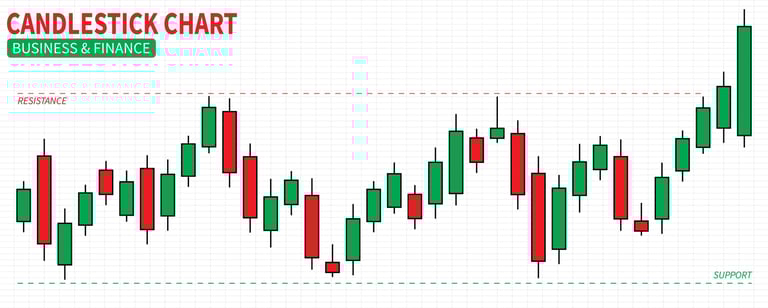
Candlestick patterns: Visual representations of price movements that help identify potential reversals or continuations
Support and resistance levels: Price points where securities tend to stop falling (support) or rising (resistance)
Stop losses: Predetermined price points where you automatically sell to limit your losses
Technical indicators: Tools like the Relative Strength Index (RSI), Moving Average Convergence Divergence (MACD), and Bollinger Bands that help gauge momentum, volatility, and potential price direction
However, even with these tools, trading is not an exact science. You can use probabilities and statistical analysis to improve your odds, but you cannot predict market movements with 100% certainty. This means you might exit positions too early (leaving money on the table) or too late (taking larger losses than necessary).
Types of Trading
1. Scalp Trading (Scalping)
This is the most aggressive form of trading, where positions are held for seconds to minutes. Scalpers make numerous trades throughout the day, aiming to profit from tiny price movements. This requires:
Constant screen time and intense focus
Very high pain tolerance for rapid losses and gains
Sophisticated technology for fast execution
Deep understanding of order flow and market microstructure
2. Day Trading
Day traders open and close all positions within a single trading day, never holding overnight. Positions typically last from minutes to hours. This approach:
Requires full-time commitment during market hours
Demands strong discipline and emotional control
Focuses on intraday volatility and news events
Avoids overnight risk (gap risk)
3. Swing Trading
This is a middle ground between trading and investing. Swing traders hold positions for several days to several weeks, aiming to capture larger price swings. This approach:
Requires less screen time than day trading
Allows you to maintain other professional commitments
May provide dividend payments if trading equities
Focuses on medium-term technical and fundamental trends
Offers a balance between active trading and long-term investing
Swing trading is often preferred by those who want exposure to trading profits but cannot dedicate their entire day to monitoring markets.
4. Position Trading
Position traders hold securities for weeks to months, blurring the line between trading and investing. This approach:
Emphasizes major trend movements
Requires less frequent monitoring
May capture dividends and longer-term fundamental shifts
Involves lower transaction costs due to less frequent trading
Volatility And Trying to Beat The Market
A couple of reasons traders prefer short-term trading over long-term investment is because of the liquidity and flexibility—you have your money available to you whenever you want, and you can take advantage of other opportunities as and when they become available. Also, the main driver is the idea that you can beat the market. The price movements per security are not that huge when you are only looking at the short-term perspective; you can see the price move by 1% a day, and when you are solely looking at maximizing your R1 instantly after injecting it into the market, you might be tempted to turn this 1% five times a day to make 5% instead of 1%. This not as easy as it may look.
I've been trading gold since May 2024. When I placed my first trade, gold was $2,418 an ounce. Today it's at $4,987 an ounce—a 106% gain if I had simply invested and held instead of trading short-term. In my early days, I tried scalp trading, holding positions for just a few minutes and closing as soon as the price moved against me. It's safe to say I was losing money doing this. I eventually changed my strategy to use longer timeframes, but I still haven't captured anywhere near that 106% return yet.
Understanding Long and Short Positions
In trading terminology, your position represents where you stand based on your market outlook:
Long position: You've bought a security because you believe its price will increase. You profit when the price goes up.
Short position: You've borrowed and sold a security because you believe its price will decrease. You profit when the price goes down and you can buy it back cheaper. (Note: Short selling involves significant risks and isn't available for all securities or in all markets.)
The Time Commitment
Active trading, particularly scalping and day trading, demands significant time and attention. You need to:
Monitor screens constantly during trading hours
Stay current with breaking news and economic data
Interpret how news will impact specific securities
Manage multiple positions simultaneously
Maintain emotional discipline under pressure
For example, consider recent U.S. inflation data that came in below forecasts. At first glance, lower inflation seems positive for the U.S. dollar. Since gold typically moves inversely to the dollar, you might expect gold to fall. However, experienced traders know to dig deeper: lower inflation increases the likelihood of interest rate cuts by the Federal Reserve (as discussed in our previous article on the relationship between inflation and interest rates). Rate cuts typically weaken the dollar and support gold prices. The immediate market reaction might differ from the obvious interpretation, and traders must quickly assess these dynamics.
The Risk-Reward Ratio
Successful trading requires maintaining a favorable risk-reward ratio. Ideally, you should risk $1 to potentially gain $2 or more. If you're risking $1 to gain $1, the mathematics work against you because:
You need to win more than 50% of the time just to break even
Transaction costs (fees, spreads, slippage) erode profits
The psychological toll of equal risk-reward isn't justified
Professional traders typically aim for risk-reward ratios of 1:2, 1:3, or higher. This means that even if they're only right 40-50% of the time, they can still be profitable overall.
The Evolution of Trading in South Africa
The trading landscape has transformed dramatically over the past decade. When I first explored trading in 2017, the process was vastly different from today:
Then (2017):
Most trades required calling a broker or using clunky trading desks
Transaction costs were prohibitively high for small traders
I used ABSA as my broker, and the fees were so expensive that selling small positions sometimes cost more than the shares were worth
In 2021, I literally had to donate five RMB shares that I held with ABSA because selling them was going to be more expensive than the money I was going to get from the sale of the shares
Limited online platforms and tools for retail traders
Long execution times for trades
High costs for retail traders (barriers to entry)
Today:
Lightning-fast algorithmic execution is standard across platforms
Low-cost online brokers like EasyEquities have democratized access
Commission-free or very low-cost trading is widely available
Mobile apps allow trading from anywhere
Advanced charting tools and real-time data are accessible to everyone
Fractional shares allow you to invest small amounts
This evolution has lowered barriers to entry, but it's also created new challenges. Easier access means more people can trade without adequate preparation or understanding of the risks involved.
Investing: The Long-Term Approach
How Investing Works
Investors focus on the fundamental value of securities and their potential to grow over extended periods. Rather than worrying about daily or weekly price fluctuations, investors ask questions like:
Is this company financially healthy?
Does it have a competitive advantage in its industry?
Will it likely be more valuable in 5, 10, or 20 years?
Does it pay dividends that can compound over time?
Ignoring the Noise
While traders capitalize on market noise, investors deliberately ignore it. They understand that markets are volatile in the short term but tend to trend upward over long periods. For example, the JSE Top 40 index—which tracks South Africa's 40 largest companies by market capitalization—has historically provided positive returns over multi-decade periods despite experiencing significant short-term volatility. Similarly, global indices like the S&P 500 have averaged 7-10% annual returns over extended timeframes, though past performance doesn't guarantee future results.
When prices drop temporarily due to market panic, negative news, or economic uncertainty, long-term investors often see this as an opportunity to buy quality assets at a discount. They're willing to endure short-term paper losses, knowing that:
Quality companies tend to recover and grow over time
Economic cycles are normal and temporary
Time in the market typically beats timing the market
The Power of Compounding
One of the greatest advantages of long-term investing is compound growth. This occurs when your returns generate their own returns. For example:
You invest R10,000 in a stock
After year one, it grows 10% to R11,000
After year two, you earn 10% on R11,000 (not just your original R10,000), giving you R12,100
This snowball effect accelerates over time
Add in reinvested dividends, and the compounding effect becomes even more powerful. This is why Albert Einstein allegedly called compound interest "the eighth wonder of the world."
Diversification
Long-term investors typically practice diversification—spreading investments across different assets, sectors, and sometimes geographies. This reduces risk because poor performance in one area can be offset by better performance elsewhere.
Using our cattle example: Rather than keeping all your cows, you might sell some to invest in other assets like farmland, equipment, or even different types of livestock. Similarly, a diversified investment portfolio might include:
Stocks from various industries (technology, healthcare, consumer goods, financials)
Bonds for stability and income
Real estate or REITs (Real Estate Investment Trusts)
International investments for geographic diversification
Lower Costs
Investing typically involves lower transaction costs than active trading because:
You buy once and hold, minimizing brokerage fees
You avoid the bid-ask spread that traders pay with each transaction
Lower turnover means fewer taxable events (in many jurisdictions, long-term capital gains are taxed more favorably than short-term gains)
No need for expensive real-time data feeds or trading platforms
Comparing Risks and Rewards
Trading Risks
Higher transaction costs: Frequent buying and selling adds up
Emotional stress: Constant monitoring and rapid decisions can be psychologically draining
Time intensive: Active trading often requires full-time attention
Greater loss potential: Leverage and rapid movements can lead to significant losses
Skill dependent: Requires sophisticated understanding of technical analysis, market psychology, and risk management
Tax implications: Short-term capital gains are often taxed at higher rates
Trading Potential Rewards
Quick profits: Successful traders can generate returns faster than long-term investors
Profit in any market: With short selling and other strategies, traders can profit from both rising and falling markets
Active income potential: Trading can become a primary source of income for skilled practitioners
Flexibility: Ability to adjust quickly to changing market conditions
Investing Risks
Opportunity cost: Missing out on short-term profit opportunities
Requires patience: Your capital is tied up for extended periods
Market risk: Long-term holdings still experience volatility, though it typically smooths out over time
Company-specific risk: Individual companies can fail, even over long periods
Investing Potential Rewards
Compound growth: Returns build on returns over time
Lower stress: Less monitoring and fewer decisions required
Cost efficiency: Minimal transaction costs and favorable tax treatment
Proven track record: Historical data shows that long-term, diversified investing has consistently built wealth
Passive income: Dividend-paying stocks provide regular income streams
Time freedom: Doesn't require constant attention, allowing you to focus on other pursuits
Critical Mistakes to Avoid
Regardless of whether you choose trading or investing, certain mistakes can be financially devastating:
1. Using Borrowed Money (Credit Cards or Loans)
Never trade or invest with money you've borrowed on credit cards or through high-interest loans. The guaranteed cost of that debt (often 15-25% annually for credit cards) almost certainly exceeds your potential investment returns. If your trades or investments lose value, you'll still owe the full amount plus interest, potentially creating a debt spiral.
2. Using Retirement Funds
Your pension or retirement funds have special tax advantages and legal protections. Withdrawing them early typically involves:
Heavy tax penalties (often 20-40% or more)
Loss of compound growth over the remaining years until retirement
Reduced financial security in your later years
The potential returns from trading or risky investments rarely justify sacrificing your retirement security.
3. Investing Money You Can't Afford to Lose
Only invest or trade with money that, if lost completely, wouldn't impact your ability to pay rent, buy food, cover medical expenses, or meet other essential obligations. A common guideline is to maintain 3-6 months of living expenses in an emergency fund before seriously investing or trading.
4. Lack of Education and Preparation
Jumping into markets without understanding how they work, how to analyze securities, or how to manage risk is gambling, not investing or trading. Take time to:
Learn the fundamentals of financial markets
Understand the specific assets you're trading or investing in
Practice with paper trading (simulated trading with fake money) before risking real capital
Start small when you do begin with real money
5. Emotional Decision-Making
Fear and greed drive poor decisions. Common emotional mistakes include:
Panic selling during market downturns
Chasing hot stocks or trends (FOMO - Fear of Missing Out)
Holding losing positions too long, hoping they'll recover
Taking excessive risks after wins (overconfidence)
Successful traders and investors develop disciplined systems and stick to them regardless of emotional impulses.
Which Approach Is Right for You?
The answer depends on several personal factors:
Consider trading if you:
Have significant time to dedicate to market monitoring
Enjoy analyzing charts, data, and news
Can handle stress and rapid decision-making
Have strong emotional discipline
Are willing to invest heavily in education and practice
Have capital you can afford to lose while learning
Consider investing if you:
Have limited time for active market involvement
Prefer a more passive, hands-off approach
Want to build wealth gradually over time
Value lower stress and fewer decisions
Are saving for long-term goals like retirement
Prefer strategies with proven historical success
Consider a hybrid approach (swing or position trading) if you:
Want some active involvement without full-time commitment
Enjoy market analysis but also value your time
Want to capture medium-term trends
Can tolerate moderate risk
Want to potentially earn dividends while also benefiting from price appreciation
The Reality Check: Most Traders Underperform
It's important to acknowledge that most active traders underperform simple buy-and-hold index investing over time. Studies consistently show that:
80-95% of day traders lose money over extended periods
Transaction costs and taxes significantly erode returns
Even professional fund managers struggle to consistently beat market indices
The average retail trader performs worse than they would by simply investing in a low-cost index fund
This doesn't mean trading is impossible—successful traders do exist—but it highlights the skill, discipline, and dedication required. If you choose to trade, approach it with realistic expectations and proper risk management.
Conclusion: Knowledge Is Your Best Asset
Whether you choose trading, investing, or a combination of both, the most important investment you can make is in your own financial education. Understand the markets, know your risk tolerance, have realistic expectations, and never stop learning.
The financial markets offer genuine opportunities to build wealth, but they also present real risks. By understanding the fundamental differences between trading and investing, you can make informed decisions that align with your goals, lifestyle, and temperament.
Remember:
Traders seek to profit from short-term volatility and market noise
Investors build wealth through long-term growth and compounding
Both require discipline, education, and proper risk management
Your choice should reflect your personal circumstances, not what sounds exciting or what others are doing
Start small, learn continuously, manage your risks, and never invest money you can't afford to lose. Your financial future depends not on finding the "perfect" strategy, but on finding the right strategy for you and executing it with discipline and patience.
Bucks Insights
Your guide to practical finance and investing.
Tips
Investing
info@bucksinsights.com
083-577-6145
© 2025. All rights reserved.