
Types of Insurance in South Africa: Investment or Protection?
Many people wonder: is insurance an investment? This article explores the different types of insurance in South Africa, the legal definitions, and how the Insurance Act 18 of 2017 works in SA, and whether your monthly premiums count as a financial investment for your future.
TRADING AND INVESTINGSOUTH AFRICA GUIDE
2/12/20268 min read
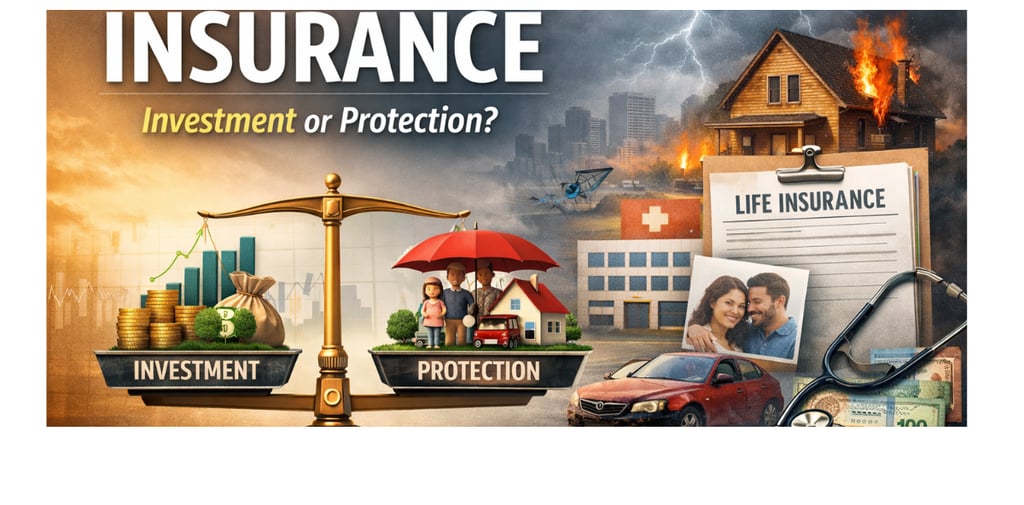
Insurance is one of the most misunderstood financial tools. Many people see it as an unnecessary monthly expense — until they need it. Others think it is an investment. But is it really?
Let's explore what insurance is, how it works in South Africa, the different types available, what they cover (and don't cover), and whether it should be viewed as an investment.
Insurance is a contractual agreement between two parties where one party (the insurer) agrees to compensate the other party (the insured) for specific financial losses resulting from defined risks or events affecting their property, life, or health.
It provides peace of mind, knowing that if anything happens to an insured item or person, you or your family will receive financial compensation to help manage the consequences.
Most people think of insurance as a guarantee: "If my car is stolen, the insurance company must replace it." However, under the Insurance Act 18 of 2017 (which replaced parts of the Long-term and Short-term Insurance Acts), insurance is not a blanket guarantee. Instead, it is a conditional contract. The law defines insurance based on the transfer of "risk." You are paying the insurer to take over the financial burden of a specific risk. With limitations, of course.
Types of Insurance Available in South Africa
Life Insurance (Long-term Insurance)
Life insurance doesn't replace your life—it replaces your income and provides financial security for your dependents when you can no longer provide for them. This type of insurance covers several critical scenarios:
Death benefit: A lump sum paid to beneficiaries upon your death
Disability cover: Income replacement if you become permanently disabled and unable to work
Severe illness cover: A payout if you're diagnosed with a critical illness like cancer, heart attack, or stroke
Income protection: Monthly payments if you're temporarily unable to work due to illness or injury
The value of life insurance extends beyond the financial. It ensures your children's education continues, your mortgage gets paid, and your spouse doesn't face financial difficulties during an already devastating time. Without it, families often lose their homes, pull children from school, or rely on relatives for basic needs.
What it doesn't cover: Pre-existing conditions (unless disclosed and accepted), suicide within the first two years of the policy, death resulting from illegal activities, and undisclosed information that would have affected the policy terms.
Providers in South Africa include:
Sanlam, Old Mutual, Momentum, Liberty, Discovery Life, ABSA Life, FNB Life, Standard Bank Insurance, and other licensed life insurers.
Funeral Insurance (Burial Cover)
Funeral insurance covers the costs associated with your funeral and burial, including:
Funeral service and venue costs
Coffin or casket
Transportation
Tombstone
Groceries for the mourning period (some policies)
Cover for extended family members (some policies)
Funeral costs in South Africa can range from R15,000 to R50,000 or more. This insurance ensures your family doesn't have to scramble for funds or go into debt during their time of grief.
What it doesn't cover: Typically excludes death from suicide in the first six months, death during criminal activity, and deaths occurring outside South Africa (depending on the policy).
Providers include:
AVBOB, Cebolethu, Doves, Assupol, Sanlam, Old Mutual, and various bank-affiliated insurers.
Credit Life Insurance (Credit Protection)
Credit life insurance is designed to pay off your outstanding debts if you die, become disabled, or lose your income. It's commonly offered with:
Home loans (bonds)
Vehicle finance
Personal loans
Credit cards
Store accounts
This protection prevents your family from inheriting your debts and ensures you don't default on payments during financial hardship.
What it doesn't cover: Voluntary unemployment, pre-existing medical conditions (unless disclosed), and debts incurred after the policy's effective date.
Important note: Credit life is often overpriced and overlapping. Review whether standalone income protection or life insurance might offer better value.
Providers include:
Major banks (ABSA, FNB, Standard Bank, Nedbank, Capitec), retail credit providers, and independent insurers.
Medical Aid (Health Insurance)
Medical aid is arguably one of the most valuable forms of insurance in South Africa, given the high cost of private healthcare. It covers:
Hospital admissions and surgeries
Chronic medication (for prescribed conditions)
GP and specialist consultations
Emergency medical services
Day-to-day medical expenses (depending on the plan)
The South African government incentivizes medical aid through tax credits (Medical Scheme Fees Tax Credit), effectively reducing the after-tax cost of your contributions.
What it doesn't cover: Cosmetic procedures (unless medically necessary), over-the-counter medication (unless you have some Savings portion on your medical aid plan), alternative therapies not approved by the scheme, and expenses beyond your annual limits or savings account balance.
Medical schemes in South Africa include:
Discovery Health, Bonitas, GEMS, Momentum Health, Fedhealth, Medshield, and Bestmed.
Household Contents and Personal Possessions Insurance
This short-term insurance covers portable items such as:
Cellphones and tablets
Laptops and computers
Jewelry and watches
Clothing and personal items
Household appliances (TVs, fridges, washing machines)
Furniture
Coverage typically includes theft, damage, and loss (though terms vary significantly between insurers).
What it doesn't cover: Wear and tear, mechanical breakdown, unexplained disappearance, or items left unattended in public places. Many policies also have specific limits for high-value items like jewelry.
Providers in South Africa include:
Santam, OUTsurance, MiWay, King Price, Discovery Insure, Hollard, Old Mutual Insure, Momentum Insure, Dialdirect, and Naked Insurance
Building Insurance (Homeowners Insurance)
Building insurance covers the physical structure of your home against:
Fire and explosion
Storm and flood damage
Impact damage (e.g., falling trees, vehicle collision)
Burst geysers and water damage
Vandalism and malicious damage
Lightning strikes
This includes permanent fixtures like built-in cupboards, geysers, stoves, and the building's structure itself (walls, roof, foundations).
What it doesn't cover: Gradual deterioration, poor maintenance, subsidence in certain areas, and damage from excluded perils. Most policies also exclude wear and tear on older roofs or geysers beyond a certain age.
Providers include:
OUTsurance, Santam, MiWay, King Price, Naked Insurance, Dialdirect, Discovery Insure, Momentum Insure, Old Mutual Insure, and major bank insurers.
Vehicle Insurance
Car insurance comes in three main types:
Comprehensive cover: Covers damage to your vehicle from accidents, theft, hijacking, fire, and natural disasters
Third-party, fire, and theft: Covers damage you cause to others and protects your car against fire and theft only
Third-party only: Covers only damage you cause to other people's property or injuries to others
What comprehensive cover doesn't include: Wear and tear, mechanical or electrical breakdowns, damage from driving under the influence, using the vehicle for unauthorized purposes (e.g., racing), and driving without a valid license.
Providers include:
OUTsurance, Santam, MiWay, King Price, Naked Insurance, Dialdirect, Discovery Insure, Momentum Insure, Old Mutual Insure, and major bank insurers.
Pet Insurance
Pet insurance helps cover veterinary costs including:
Accidents and injuries
Illnesses and diseases
Surgery and hospitalization
Certain routine care (depending on the plan)
Emergency treatments
Veterinary costs can be substantial—a single emergency surgery can cost R15,000-R40,000.
What it doesn't cover: Pre-existing conditions, elective procedures (like tail docking), breeding-related costs, and preventative care like vaccinations (unless you have a wellness plan).
Providers in South Africa include:
Dotsure, Oneplan Pet Insurance, MediPet, OUTsurance Pet, and Affinity Pet Insurance.
What Does Insurance Cost You?
Understanding the true cost of insurance is essential:
Monthly Premiums
This is the regular amount you pay to keep your insurance active. Premiums vary based on:
The type and amount of cover
Your age, health, and risk profile
Your claims history
The excess you choose
Excess (or Deductible)
The excess is the amount you pay out of pocket when claiming. For example, if your car suffers R30,000 in damage and your excess is R5,000, you pay R5,000 and the insurer pays R25,000. Higher excesses typically mean lower monthly premiums.
Co-payments (Medical Aid)
Some medical aid plans require you to pay a percentage of certain expenses (e.g., 20% of a specialist visit). This shares the cost burden between you and the medical scheme.
Opportunity Cost
Money paid to insurance could have been invested elsewhere. We also covered this in our investment vs trading article.
Waiting Periods
Many policies have waiting periods (especially medical aid and pet insurance) before you can claim for certain conditions—this is a hidden cost in terms of uncovered risk.
Premium Increases
Insurance premiums typically increase annually, often above inflation, which means the real cost accumulates significantly over your lifetime.
Is Insurance an Investment?
In our previous article, we defined an investment as "an allocation of resources—usually money—with the expectation of that thing generating profits or income in the future."
The case for insurance as an investment:
You pay money (premiums) expecting future financial benefit (claims)
You receive compensation (income) when an insured event occurs
Over a lifetime, some people receive more in claims than they paid in premiums
The case against insurance as an investment:
Insurance is protection, not growth: Unlike investments, insurance doesn't grow your wealth—it prevents wealth destruction
Negative return for most: The insurance industry is profitable because most policyholders pay more in premiums than they receive in claims
No guaranteed return: If you never claim, you receive nothing back (unlike investments which should provide returns)
You can't cash out: Most insurance has no surrender value; stop paying and you lose all benefits
It's a consumption expense: Insurance is more accurately classified as a necessary expense to protect against catastrophic financial loss
But What About Policies With Investment Components?
Some products combine insurance and investment, such as:
Endowment policies: Some life insurance products have a "savings" component where a portion of your money is invested in the markets
Whole life policies with cash value
Retirement annuities with life cover
In these cases:
One part protects risk
One part accumulates savings
However, even then, the insurance portion is not an investment — it is still risk cover.
The Better Way to Think About Insurance
Insurance is not an investment—it's a risk management tool and a form of financial protection.
Think of insurance this way: You're paying a relatively small, manageable amount to avoid a potentially devastating financial loss. You're transferring risk from yourself to an insurance company in exchange for premiums.
When insurance makes sense:
When the potential loss would be financially catastrophic (death, disability, total loss of home)
When you have dependents relying on your income
When you're legally required to have it (e.g., vehicle third-party insurance)
When you cannot afford to self-insure (replace the item from savings)
When insurance might not make sense:
For small items you can afford to replace
When premiums exceed the realistic replacement cost over time
When you have sufficient savings to cover the potential loss
When you're over-insured with duplicate coverage
Bucks Insights Tips for Insurance in South Africa
Don't under-insure: Ensure your coverage amounts are adequate. Under-insurance on building insurance, for example, can result in proportional payouts that don't cover your full loss.
Review annually: Your insurance needs change as your life changes. Review all policies annually to ensure they still meet your needs.
Compare providers: Don't automatically renew. Get quotes from multiple providers—prices vary significantly.
Read the fine print: Understand what's excluded, waiting periods, and claim procedures before you need to claim.
Consider increasing your excess: If you have emergency savings, a higher excess can significantly reduce your monthly premiums.
Bundle wisely: Some insurers offer discounts for multiple policies, but ensure each individual policy is competitively priced.
Disclose everything: Non-disclosure can void your entire policy. Be honest about pre-existing conditions, modifications, or risk factors.
So… Is Insurance Worth It?
Yes, but strategically. Insurance is not an investment—it won't make you wealthy. However, the right insurance can prevent financial catastrophe and is essential for responsible financial planning, especially if you have dependents.
It basically depends on these questions that you have to ask yourself:
Do you have dependents? If yes, Life Insurance is essential.
Could you afford to replace your car or house tomorrow? If no, Comprehensive/Building insurance is essential.
Is the item a small "inconvenience"? If losing your cellphone wouldn't break your budget, you might be better off "self-insuring" by putting that premium into a savings account instead.
Prioritize insurance in this order:
Life insurance (if you have dependents)
Medical aid
Building insurance (if you own property)
Vehicle insurance (at minimum third-party)
Income protection/disability
Other insurance based on individual circumstances
Remember: The best insurance is the one you never have to use, but are grateful you had when disaster strikes. Don't view insurance premiums as wasted money—view them as the price of peace of mind and financial security.
Think of insurance as the foundation of a house. It is not visible wealth — but without it, everything above it can collapse the moment natural disasters hit.
Insurance protects what you've built. Investments build your future. You need both, but they serve fundamentally different purposes in your financial life.
Bucks Insights Summary: Insurance vs Investment
Bucks Insights
Your guide to practical finance and investing.
Tips
Investing
info@bucksinsights.com
083-577-6145
© 2025. All rights reserved.