Savings And Investment Vehicles in South Africa (Part 2): ETFs, Commodities & Private Debt
In Part 1, we covered the basic savings and investment vehicles in South Africa — Savings Accounts, Fixed Deposits, Bonds, the Stock Market, and Unit Trusts. In Part 2, we're levelling up. We are diving into ETFs, Commodities, and Private Debt.
TRADING AND INVESTINGSOUTH AFRICA GUIDE
3/24/202617 min read
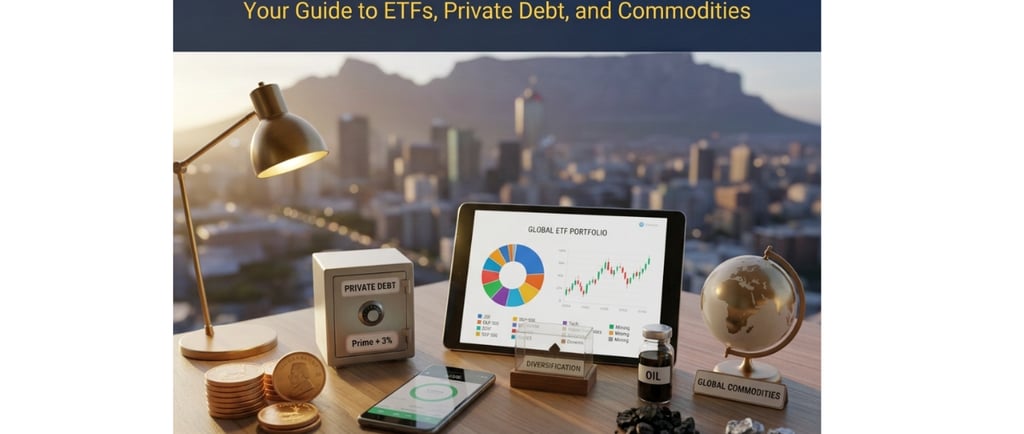
ETF — Exchange Traded Funds
Before we get into ETFs specifically, let's make sure two building blocks are clear: what a fund is, and what an exchange is.
What is a fund?
Think of it like a Stokvel. A group of people pool their money together, and that pooled money becomes the fund. Before it goes anywhere or does anything — while it's still sitting in the account — that is the fund. What happens next depends on the strategy. In a Stokvel, the strategy might be lending money out at interest, or paying it out to members in turns. In the investment world, the strategy is what determines what type of fund it is, and how it makes money for the people who put money in.
What is an exchange?
We covered this in our investing fundamentals article. An exchange is simply a marketplace — where financial securities are bought and sold. Just like a physical market is where you go to buy tomatoes and spinach, or thrifting, a financial exchange is where you go to buy and sell shares, bonds, and other financial instruments. In South Africa, that marketplace is the JSE — the Johannesburg Stock Exchange.
Now, back to ETFs.
An ETF — Exchange Traded Fund — is exactly what the name says: a fund that is traded on an exchange. You buy and sell it on the JSE the same way you would buy and sell an ordinary share.
But here is the key difference from a unit trust: an ETF does not have a fund manager making active decisions about which companies to pick. Instead, it tracks an index — a predefined basket of assets built around a set of rules. The most well-known example in South Africa is the FTSE/JSE Top 40 Index, which simply tracks the 40 biggest companies listed on the JSE. If you buy an ETF that tracks the Top 40, your money is spread across all 40 of those companies, in proportion to their size. No one is deciding every morning which shares to buy — the index rules do that automatically.
This is called passive investing. The fund doesn't try to beat the market; it tries to match it.
Think of it this way: in Part 1, we described a unit trust as a fund manager filling a basket for you based on their expertise and judgment. An ETF is a basket that fills itself, based on rules agreed upfront. Because there is no fund manager making daily decisions, the costs are much lower.
South Africans have taken to ETFs enthusiastically. Among retail investors on popular platforms like EasyEquities and SatrixNOW, the most bought ETFs tend to track offshore indices — with the Satrix S&P 500 ETF consistently topping the charts. That means South Africans are using a single, low-cost product to invest in the 500 biggest companies in the United States — from their phones, in rands.
The Satrix Top 40 ETF — which tracks the biggest 40 companies on the JSE — has been voted the People's Choice ETF in South Africa for seven consecutive years. So whether you want local or global exposure, there is likely an ETF for it.
Where do you buy an ETF?
You can invest in ETFs by opening a brokerage account with an authorised JSE member, or by opening an investment plan directly with an ETF provider, either as a lump sum or via monthly debit order. In practice, the most accessible platforms for South African retail investors are EasyEquities, SatrixNOW, and ETFSA — all of which allow you to start investing from as little as R50 per month. Your bank may also offer ETF access through their investment platforms.
What do you get as a return? Your return comes from two sources. First, capital growth — the value of your ETF units rises as the underlying index rises. Second, some ETFs pay dividends when the underlying companies in the basket pay dividends. Some ETFs automatically reinvest dividends back into the fund, putting the power of compounding to work in your favour.
When do you get the return? Capital growth is realised when you sell your ETF units. Dividends, where applicable, are typically paid quarterly or semi-annually depending on the ETF.
Pros
Low cost — no active fund manager means lower fees than unit trusts
Simple and accessible — you can start with very small amounts
Diversification built in — one ETF gives you exposure to many companies at once
Transparent — you always know exactly what's in the basket
Traded on the JSE — you can buy and sell during market hours like any share
Purchases of ETFs are exempt from Securities Transfer Tax (STT)
Cons
No one is trying to beat the market for you — if the index falls, your ETF falls with it
Returns are not guaranteed
Requires a brokerage account to access, which adds a small layer of admin compared to a savings account or fixed deposit
Private Debt (Private Credit)
This one sounds complicated, but you already understand the concept.
In Part 1, we described the bond market as a way for you to become the creditor — to lend money and earn interest — rather than the saver. Private debt is that same idea, but instead of lending to the government, you are lending to businesses and projects, and instead of doing it directly, you do it through a fund.
Here's how it works: a group of investors pool their money together (yes, Stokvel again) to form a fund. That fund then lends money directly to businesses — typically for specific projects like building a block of flats, constructing a road, developing a mall, or financing a growing business. The loan bypasses the bank entirely. The businesses pay interest on the loan, and that interest is paid back to the investors in the fund as their return.
Why would a business borrow from a private debt fund instead of just going to the bank? Sometimes the bank won't lend, or the terms aren't suitable, or the business needs a structure the bank can't provide. Private debt funds can be more flexible, and in exchange for that flexibility, they charge higher interest — which means a higher return for the investors.
This is a large and growing asset class globally, and it is increasingly available to South African investors through wealth management platforms and specialised fund managers. It is not typically something you access through a standard brokerage account — private debt funds usually have higher minimum investments and are aimed at more experienced or high-net-worth investors. However, as the market matures, more accessible versions are beginning to appear.
What do you get as a return? Regular interest income, paid from the interest the businesses are paying on their loans. Returns vary depending on the type of loans in the fund, but private debt typically aims to deliver better returns than bonds or money market funds, in exchange for the higher risk and lower liquidity.
When do you get the return? Typically quarterly or semi-annually, depending on the fund structure.
Pros
Better return potential than government bonds or money market funds
Regular income stream
Less volatile than equity markets — returns are contractual (like a loan) rather than market-dependent
Offers diversification from traditional listed asset classes
Cons
Lower liquidity — your money is typically committed for a fixed term, often 3 to 7 years
Higher minimum investments compared to ETFs or unit trusts
Higher risk than government bonds — businesses can default on their loans
Less transparent and less regulated than listed products like ETFs or unit trusts
Not easily accessible to everyday retail investors yet
Commodities
What are commodities?
These are the raw materials and primary products that the world runs on. Gold, copper, oil, wheat, coal, platinum — the basic ingredients from which everything else is made. You would have encountered this word in high school, in subjects like EMS or HSS. The textbook definition is simple: a commodity is a raw material or primary agricultural product that can be bought and sold.
The "raw" in raw materials is the giveaway. Before the car, there was steel. Before the steel, there was iron ore. Before the iron ore, there was the ground. Commodities are what you start with.
And just like shares and bonds, commodities are traded on financial markets. Prices go up and down based on supply, demand, geopolitics, weather, and a host of other factors. When you understand commodities, you start to understand why the petrol price changes every month, why load shedding happened, and why the copper pipes in your neighbourhood keep disappearing.
The commodities market is broadly divided into five categories: Metals, Energy, Agricultural, Environmental, and Niche Commodities. Let's walk through each.
1. Metals
What is a metal?
In plain terms: a hard, shiny solid material that is mined from the ground, and can be shaped — either by heat or pressure — into almost any form. Think of the blacksmith scenes in Game of Thrones: iron heated in fire until it glows red, then beaten into a sword. That process captures it well. The iron becomes malleable (shapeable without breaking), and once it cools, it holds its new form.
Metals are divided into two main groups: precious metals and base metals.
Precious metals are rare, naturally occurring metals of high economic value. They are used in jewellery, investment, and specialised industrial applications.
Gold — The yellow metal everyone knows. Mined from underground deposits or extracted from sulphide ore. South Africa has a deep relationship with gold — it shaped our economy, our cities, and our history. In investment form, gold is most famously available in South Africa as the Krugerrand. There are two types: the Gold Krugerrand (22-carat gold — 91.67% gold and 8.33% copper for durability) and the Silver Krugerrand (99.9% pure silver). Gold is also used in electronics, dentistry, and as a store of value in times of economic uncertainty. When markets crash, people buy gold. That tells you something about how the world views it.
Carat — a measure of the purity of gold, with 24 carats being pure gold.
Silver — A shiny, greyish-white metal. Mined similarly to gold, and also recovered as a by-product from other ore minerals. Used in jewellery, ornaments, the Silver Krugerrand, and — interestingly — in photography. The way silver salts react to light was the basis of traditional film photography.
Platinum — A precious, silvery-white metal first encountered by the Spanish in South America in the 16th century. South Africa holds the world's largest known platinum reserves, with the Bushveld Igneous Complex in Limpopo and North West being the dominant source. Platinum is used in jewellery, catalytic converters in vehicles (which reduce harmful emissions), laboratory equipment, and industrial processes.
Palladium — A rare, silvery-white metal closely resembling platinum. Also found in South Africa's Bushveld Complex. Like platinum, it is heavily used in catalytic converters and electronics.
Base metals are more commonly found in nature, less valuable than precious metals, but absolutely essential to industry and construction.
Iron — A strong, hard, silvery-grey metal. The backbone of modern construction and manufacturing. Iron occurs naturally in ore form — haematite, magnetite, and siderite are common examples. It is not typically used in its pure form; it is almost always processed further.
Steel — Steel is not a metal on its own. It is an alloy — a material produced by combining iron with carbon (from coal or charcoal). That carbon content is what transforms brittle iron into the strong, flexible steel used in buildings, bridges, vehicles, and yes, swords. The blade being forged in the Game of Thrones forge? That's steel.
Ore — a naturally occurring solid material from which a metal or valuable mineral can be profitably extracted.
Copper — A reddish-brown metal, considered the earliest metal used by humans. Ductile (can be drawn into thin wire), excellent conductor of electricity and heat. If you grew up building wire toy cars, you know copper. If you live in South Africa, you know it from the plumbing pipes that disappear overnight — the ones that amaphara target because they fetch a decent price when sold for scrap. Copper is used in electrical wiring, plumbing, and electronics. When amaphara cut your suburb's electricity cable, they're after the copper inside it.
Lead — A dense, bluish-grey metal. Used in roofing, ammunition, and car batteries. Also used as a radiation shield, which is why the dentist puts a heavy apron on you before taking X-rays.
Nickel — A silvery-white metal that occurs naturally in combination with other metals. Its main use is in alloys — particularly with iron to add strength and corrosion resistance, and with copper for coinage. Our South African R5, R2, and 50 cent coins are made from nickel-plated steel and copper-nickel alloys — not gold or silver, despite how shiny they look.
Zinc — A silvery-white metal used in making brass (the yellowish alloy used in door fittings and decorative objects — mix copper and zinc, and you get brass) and for galvanising — coating iron and steel to protect them from rust. In South Africa, you know zinc best as corrugated iron roofing sheets. Those wavy silver roofs you see in townships and rural areas? Zinc-coated steel.
Aluminium — A light, silvery-grey metal. The most abundant metal in the earth's crust, extracted mainly from bauxite (a reddish, clay-like rock). Aluminium's combination of lightness, strength, and corrosion resistance makes it ideal for aircraft, vehicle parts, packaging, and household utensils. If you've ever noticed water dripping off a plane after landing on a clear day — that's condensation from moisture in the atmosphere at altitude, and the aluminium hull has to withstand that environment for decades.
Tin — A light, silvery-white metal, relatively rare, occurring mainly in the mineral cassiterite. Used in alloys, most notably bronze, and for coating steel to make tinplate — the material used in food cans.
Bronze — A yellowish-brown alloy of copper and tin. One of the oldest manufactured materials in human history, giving its name to the Bronze Age.
As a side note: now that we have walked through these metals, you understand why the medal system works the way it does. Bronze for third. Silver for second. Gold for first. Platinum for something even beyond that. The value of those metals in the real world maps almost perfectly to the hierarchy we use to rank achievement.
Where do you invest in metals?
In South Africa, you can gain exposure to precious metals through:
ETFs — The NewGold ETF on the JSE tracks the price of gold bullion. There is also an AfricaPalladium ETF for palladium exposure.
Mining shares — Buying shares in companies like Anglo American, Sibanye-Stillwater, or Impala Platinum on the JSE gives you indirect exposure to metal prices.
Physical gold — You can buy actual Krugerrands through major banks and selected coin dealers.
What do you get as a return? Returns on metals come primarily from price appreciation — you buy at one price and sell when the price has risen. Precious metals like gold do not pay dividends or interest. Their value comes from what someone is willing to pay for them, which tends to rise when the economy is uncertain and fall when confidence returns.
When do you get the return? When you sell.
Pros
Gold and precious metals are a reliable store of value over very long periods
Strong hedge against inflation and currency weakness — when the rand weakens, gold (priced in dollars) becomes more valuable in rand terms
South Africa is a global leader in platinum and palladium production, making local access relatively easy
Cons
No income — metals don't pay dividends or interest
Prices can be volatile in the short term
Physical metals require safe storage
2. Energy Commodities
What is energy in this context?
Energy commodities are the raw materials used to produce power — to generate electricity, heat homes, fuel vehicles, and run factories. You've seen the windmills on the N1 near Touws River. That physical spinning motion converts wind (a raw material) into electricity. Coal burning in an Eskom power station does the same thing through heat. These raw materials — the wind, the coal, the oil — are energy commodities.
Crude Oil — Unrefined petroleum. A dark, thick liquid formed over millions of years from the compressed remains of ancient marine organisms. Over geological time, heat and pressure transformed those buried organisms into liquid hydrocarbons, now trapped in underground reservoirs within rock layers — often beneath the seabed.
Petroleum — a liquid mixture of hydrocarbons present in rock strata, extracted and refined to produce petrol, paraffin, diesel, and other fuels.
The largest crude oil reserves are concentrated in the Middle East, and a significant portion of global oil trade passes through the Strait of Hormuz — a narrow waterway between Iran and Oman/UAE connecting the Persian Gulf to the open ocean. This is why conflict in that region directly affects oil prices worldwide — and why you feel it at the Engen garage at the end of the month, and it typically trickles down to the prices of food we buy as these also rely heavily on transport of these good across country.
Natural Gas — A highly flammable gas, consisting largely of methane, found underground — often alongside crude oil. Used for electricity generation, industrial heating, and cooking. The modern built-in gas hobs in kitchens use natural gas delivered via pipeline. The refillable gas cylinders most of us use at home contain Liquefied Petroleum Gas (LPG), which is a related but different product.
Coal — A combustible black or dark-brown rock formed from ancient plant matter compressed underground over millions of years. The majority of South Africa's electricity is still generated by Eskom through coal-fired power stations, most of them located in Mpumalanga. Those stations burn coal to create steam, which spins turbines to generate electricity. Now you know why load shedding and coal supply problems are so directly linked.
Petrol (Gasoline) — A refined petroleum product, used as fuel for internal combustion engines. It is the end product after crude oil passes through a refinery. When crude oil prices rise globally, petrol prices at South African pumps follow — usually within a month.
Hydrogen — A colourless, odourless, highly flammable gas. The most abundant element in the universe. It combines with oxygen to form water (two parts hydrogen, one part oxygen — H₂O). It is increasingly being explored as a clean energy source, since burning hydrogen produces only water as a by-product. South Africa is positioning itself as a potential green hydrogen producer, given our platinum reserves and solar resources.
Carbon — Not a fuel itself, but a non-metallic element central to energy commodities. It has two main pure forms — diamond and graphite — and also occurs as charcoal, soot, and coal. Carbon combined with hydrogen gives us hydrocarbons, which form the basis of all fossil fuels.
Fossil fuels — natural fuels such as coal, oil, and gas, formed from the remains of ancient living organisms. Our marine and plant ancestors, in a sense, giving us the energy to light our homes.
Where do you invest in energy commodities?
Most retail investors access energy commodities indirectly through:
Shares in energy companies — companies like Sasol (listed on the JSE) are deeply tied to oil and gas prices. When oil prices rise, Sasol tends to benefit.
ETFs — Various global ETFs track oil prices or energy sector companies.
Direct commodity trading — possible through specialised brokers using instruments called futures contracts, but this is complex and not recommended for beginners.
What do you get as a return? Price appreciation when energy commodity prices rise. Some energy company shares also pay dividends.
When do you get the return? When you sell, or through dividends if you hold shares in energy companies.
Pros
Hedge against inflation — energy prices tend to rise with inflation
Exposure to a sector that is essential and always in demand
South Africa's energy transition creates potential opportunities in new energy commodities like hydrogen and renewables
Cons
Highly volatile — oil prices can swing dramatically due to geopolitics, supply decisions by OPEC (The Organization of the Petroleum Exporting Countries) and global economic conditions
Traditional fossil fuel commodities face long-term structural decline as the world shifts to renewables
Direct commodity trading is complex and high risk
3. Agricultural Commodities
What are agricultural commodities?
These are the crops, livestock, and raw agricultural materials that feed the world and supply its industries — wheat, maize, soybeans, coffee, cotton, cattle, sugar, and more. They are among the oldest traded commodities in human history, and they remain deeply important today.
South Africa's agriculture sector is not a side story. The agriculture, forestry and fishing sector contributed R134.8 billion to South Africa's GDP in 2025, posting 17.4% year-on-year growth — the strongest performance of any sector in the economy. This came after two consecutive years of contraction, making the rebound even more significant. The growth was supported by bumper harvests, record agricultural exports, and favourable production conditions, even as the sector navigated US tariffs and animal disease outbreaks.
To put that in perspective: South Africa's overall GDP grew by 1.1% in 2025, and agriculture alone contributed 0.4 of a percentage point to that growth — punching well above its weight in the overall economy.
The main categories are:
Cereal Grains — Wheat, maize, rice, barley, and oats. These are the staple foods that feed people and livestock across the globe. South Africa is a significant producer of maize in particular — it is a staple food (think pap) and a major export crop.
Oilseeds — Soybeans, sunflower seeds, canola, and peanuts. These are crushed to produce cooking oils and animal feed. South African sunflower production is substantial, particularly in the North West and Free State provinces.
Soft Commodities — Tropical and semi-tropical products including coffee, cocoa, sugar, cotton, and rubber. Called "softs" because they are grown, not mined. South Africa produces sugar cane in KwaZulu-Natal, and South African wine and citrus are significant export commodities.
Livestock and Dairy — Cattle, sheep, pigs, poultry, milk, eggs, and cheese. A major component of South Africa's agricultural output. Livestock growth in 2025 was constrained by outbreaks of foot-and-mouth disease in cattle, sheep, and pigs, which disrupted both domestic trade and meat export agreements. This is a reminder that agricultural commodity prices are not just driven by markets — biology and disease play a significant role too.
Industrial Crops — Wool, tobacco, and rubber, used as raw materials in manufacturing rather than as food.
Where do you invest in agricultural commodities?
In South Africa, agricultural commodities are traded on the JSE's Commodity Derivatives Market — one of the largest and most sophisticated agricultural derivatives markets in Africa (we'll discuss derivatives when we discussing hedge funds on Part 3). Instruments like futures and options allow farmers, food companies, and investors to manage the risk of price changes. For the everyday retail investor, exposure is more practically accessed through:
Shares in agricultural companies — companies like Pioneer Foods, Tiger Brands, or Rainbow Chicken listed on the JSE.
Agricultural ETFs — available on international platforms through products that track food and agriculture indices.
What do you get as a return? Price appreciation when commodity prices rise, or dividends from agricultural company shares.
When do you get the return? When you sell your position, or through dividends from company shares.
Pros
Essential goods — food demand does not disappear regardless of economic conditions
South Africa has genuine competitive advantages in certain agricultural exports (citrus, wine, maize)
Strong recent performance, with the sector leading national GDP growth
Cons
Prices are heavily influenced by weather, drought, disease, and seasons — factors no one controls
Geopolitical tensions affect both input costs (fertiliser, fuel) and export market access
Direct commodity trading requires specialist knowledge and is complex
4. Environmental and Alternative Commodities
This is an emerging category — one that did not really exist as an investable asset class a generation ago. It has grown out of the global effort to reduce carbon emissions, transition to renewable energy, and create more sustainable supply chains.
The most well-known instrument in this category is the carbon credit. Here is how it works: governments and international bodies set limits on how much carbon (greenhouse gas) companies are allowed to emit. If a company emits less than its allowed limit, it earns carbon credits — which it can sell to other companies that are over their limit. This creates a market for carbon, with a price that rises as emission limits tighten.
Other instruments in this category include:
Renewable Energy Certificates (RECs) — certificates that verify a unit of electricity was produced from a renewable source (solar, wind, hydro). Energy companies and corporations buy these to demonstrate or offset their carbon footprint.
Recycled Materials — metals, plastics, and fibres recovered from waste streams are increasingly traded as commodities in their own right, driven by demand for sustainable supply chains.
This category is heavily influenced by government policy. The value of a carbon credit depends on what limits governments set and enforce. In South Africa, a carbon tax has been in place since 2019, and the carbon market is developing — though it is still in early stages compared to the EU's Emissions Trading System.
For most South African retail investors, this remains a specialised and relatively inaccessible market. However, it is worth understanding, because the energy transition is one of the most significant economic shifts of this century, and it will reshape which commodities are valuable and which are not.
What do you get as a return? Price appreciation of the carbon credits or certificates you hold, as demand increases and supply tightens through regulation.
When do you get the return? When you sell.
Pros
Potential for strong returns as global climate regulation tightens
Growing asset class with increasing institutional interest
Diversification from traditional commodities
Cons
Returns depend heavily on government policy — a change in political direction can dramatically affect prices
Limited accessibility for retail investors in South Africa currently
Highly specialised — requires significant research and understanding
5. Niche and Alternative Commodities
This category covers specialised raw materials that do not fit neatly into the four categories above, but are increasingly important — particularly due to the rise of electric vehicles, artificial intelligence, and advanced electronics.
Rare Earth Metals and Battery Materials — Lithium, neodymium, dysprosium, and cobalt are essential for electric vehicle batteries, wind turbines, and high-tech electronics. Demand for these materials is growing rapidly as the world electrifies. South Africa has deposits of several of these materials, though the sector is underdeveloped relative to its potential.
Specialty Agricultural Products — Certain niche crops like palm oil, oats, and specialised livestock breeds sit outside the main agricultural commodity categories. Palm oil, in particular, is one of the most widely traded agricultural commodities in the world, found in everything from cooking oil to cosmetics to biofuel.
Specialty Petrochemicals — Specific chemical compounds derived from oil and gas refining, used in plastics, pharmaceuticals, and industrial applications. These are distinct from crude oil trading.
The niche commodities space is characterised by high volatility, limited regulation, and strong growth potential. These markets are often driven by very specific technological or industrial trends — the surge in EV production driving lithium demand being the clearest recent example.
Where do you invest in niche commodities?
Mostly through:
Mining and technology company shares on the JSE or international exchanges
Thematic ETFs focused on electric vehicles, clean energy, or battery technology — available through platforms like EasyEquities
What do you get as a return? Primarily price appreciation, with some dividend income from company shares.
When do you get the return? When you sell.
Pros
High growth potential, particularly in materials linked to the energy transition
Diversification from mainstream asset classes
South Africa has natural resource endowments that could benefit from rising demand
Cons
High volatility — niche commodity prices can move dramatically
Illiquid markets — some of these materials are not easily traded at retail level
Requires significant research to invest intelligently
Regulatory and geopolitical risks are high
We hope this article helps you see how everything happening in the world — the wars, the weather, the policies, the technology shifts — connects back to your wallet, and how understanding these connections can help you take advantage of opportunities and anticipate changes before they arrive.
Part III will cover Cryptocurrency, Hedge Funds, and Property. Watch this space.
Bucks Insights
Your guide to practical finance and investing.
Tips
Investing
info@bucksinsights.com
083-577-6145
© 2025. All rights reserved.