
Major South African News Events That Affect You: SONA, BUDGET & Interest Rates
Wondering how SONA 2026 and the Budget Speech impact your wallet? Discover the major South African news events that determine taxes, interest rates, and water security.
MONEY BASICSSOUTH AFRICA GUIDETRADING AND INVESTING
2/17/20269 min read
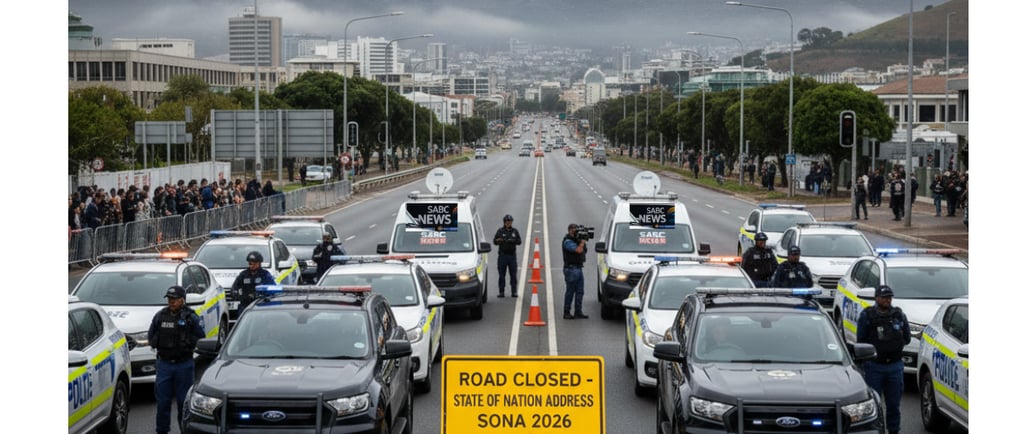
You've probably seen the roads closed around the State of the Nation Address or Budget Speech and wondered why it's such a big deal. These aren't just political ceremonies. They directly influence your taxes, your electricity, your water, your job prospects, and your loan repayments. They also shape how South Africa is viewed — and rated — by the rest of the world.
Before we get into the events themselves, there's something worth understanding first, because it changes how everything else in this article makes sense.
The Year Is Not Always What You Think
Growing up, the year meant one thing: 1 January to 31 December. Simple, clean, universally understood.
But the moment you step outside of everyday life and into the world of business or government, "the year" means something different. In business, this is called the financial year — and a company can actually choose when it starts and ends. A company could run its financial year from 1 July to 30 June and that would be perfectly legal. The year doesn't have to follow the calendar, you specify this date in your company’s Memorandum of Incorporation (MOI)—a document that works like a constitution for the country.
Why does this matter? Because two important things happen at a company level based on this financial year:
At the start of the year, a company prepares its budget — commitments on how much will be spent in each area of the business, just like a personal budget.
At the end of the year, it produces annual financial reports — the story of how the company actually performed. Did it make a profit or a loss? What investments were made? What debts were incurred? What's actually in the bank?
The government or parliament works exactly the same way. South Africa's financial year runs from 1 March to 28 February.Which means that as February rolls around, we are in the final month of the financial year. This is the moment to pay attention — the government is wrapping up, accounting for the year that's ending, and laying out what it promises for the year ahead.
At the government or parliament level, though, it goes much further than a company's annual report. A country doesn't just track income and expenses — it competes and trades on a global scale. It exports commodities it produces and imports what it doesn't have. At this level, we stop talking about financial matters and start talking about economic matters — meaning it affects trade, growth, employment, investment flows, and the value of the rand.
South Africa trades globally. We export minerals, agricultural goods and manufactured products. We import fuel, machinery, and technology. Economic credibility therefore matters international.
Government policy is split into two distinct lanes:
Fiscal policy — everything to do with taxes and government spending—Managed by National Treasury.
Monetary policy — everything to do with interest rates and money supply—Managed by the Central Bank.
The four events we're covering all feed into one or both of these lanes. Once you understand that, the whole picture starts to make sense.
SONA — State of the Nation Address
What is SONA?
SONA is delivered annually by the President of South Africa — currently Cyril Ramaphosa at the time of writing — from Parliament. Think of it as the country's annual report card and national roadmap combined, read out loud to the country.
The name says it all. The "State" is the condition. The "Nation" is South Africa. The "Address" is the President speaking directly to us — and also addressing what urgently needs fixing.
SONA is the broadest of all the events we cover here. Unlike the Budget Speech or interest rate decision, which zoom into specific sectors, SONA covers everything: the economy, crime, infrastructure, water, energy, healthcare, education, governance. It's the one moment where the government steps back and gives us the full picture.
What does SONA actually cover?
At the 2026 SONA, the key issues addressed included:
Economic growth — GDP performance, investment targets, job creation, and support for small businesses.
Crime and safety — Gang violence, police reform and recruitment, military deployment in high-crime areas, and anti-corruption efforts.
Infrastructure — Water crisis management (with R156 billion committed to water infrastructure over three years), energy security, transport, roads, and digital infrastructure.
Social development — Education, public healthcare, social grants, and youth employment.
Governance — Public sector efficiency, anti-corruption, immigration, land reform.
Who it affects and how
Citizens — Policies set here affect electricity supply, water availability, job opportunities, and safety. If a national committee is announced, it's because the problem is serious enough that it now has government resources behind it.
Businesses — Infrastructure commitments and economic policy directly affect how businesses plan and grow.
Investors — SONA signals government priorities. Foreign investors watch it closely to decide whether South Africa is a place worth putting money into.
Global community — Rating agencies and trading partners use SONA to assess whether South Africa's leadership is serious and credible.
When does it happen?
SONA is delivered annually in February, usually on the second Thursday of the month. It marks the official opening of Parliament's annual programme. The 2026 SONA was delivered on 12 February 2026.
Budget Speech
What is the Budget Speech?
If SONA sets the vision, the Budget funds it.
Delivered by the Finance Minister — currently Enoch Godongwana at the time of writing — the Budget Speech is the government's financial plan for the year ahead. It has two sides:
The spending side covers how government money flows back to the public — grants, healthcare, education, roads, and public services. If you receive a social grant, this is when the new amounts are announced.
The revenue side covers how the government plans to collect the money to fund all of that. This is where your salary comes in. Changes to income tax brackets take effect almost immediately after the speech, meaning a rate change announced on a Wednesday afternoon can affect your next payslip.
What does the Budget cover?
Social support — Social grants (child support, old age pension, disability grants), school nutrition programmes, and university funding.
Healthcare — Public hospitals, clinics, and medicine. In recent years, R848 billion was allocated to health over the medium-term expenditure framework.
Infrastructure — Roads, bridges, water and sanitation, electricity, and government facilities.
Public services — Police, defence, courts, Home Affairs, and general government administration.
Tax changes — Income tax bracket adjustments, VAT, fuel levies, corporate tax, and sin taxes on alcohol and tobacco. Every year, without fail, that bottle of wine and that pack of cigarettes gets more expensive.
Budget deficit — How much the government plans to borrow to cover shortfalls.
Public debt — How much South Africa owes in total and the plan to stabilise it.
Why the debt numbers matter
This is where credit rating agencies enter the picture. Agencies like Moody's, S&P Global, and Fitch Ratings study every Budget Speech and assess whether South Africa's debt is on a sustainable path. Their verdict matters enormously:
A downgrade means:
The rand weakens
Borrowing costs rise across the board
Home loans and car finance become more expensive indirectly
An upgrade or stable outlook means the opposite — confidence grows, the rand steadies, and money flows in.
Changes Recently Introduced
In the 2024 Budget Speech, for instance, the government announced no increase to the general fuel levy — a saving of roughly R4 billion for consumers. Social grants were increased in line with inflation. The two-pot retirement system was introduced, allowing limited early access to pension funds. These weren't abstract policy decisions. They showed up in wallets and bank accounts.
You'll also remember the 2025 Budget Speech, when a proposed VAT hike triggered parliamentary debate and was ultimately reversed. That back-and-forth showed exactly how the process is meant to work — the Budget isn't a final decree. Parliament debates it, pushes back, and the government adjusts. On the day the VAT reversal was announced, load shedding made a brief, mysterious return for exactly one day. I'm sure it was unrelated.
Who it affects and how
Taxpayers — Tax bracket changes affect what you take home every month, starting from the next payslip.
Grant recipients — Millions of South Africans depend on grants. Any adjustment hits immediately.
Businesses — Corporate tax rates, incentives, and infrastructure spending directly affect the operating environment.
Consumers — Fuel levies and VAT flow into the price of almost everything.
Government departments — Their annual allocation is determined here.
Rating agencies and investors — The Budget tells them whether South Africa is managing its finances responsibly.
When does it happen?
The Budget Speech is delivered in February, typically one to two weeks after SONA, on a Wednesday afternoon. The 2026 Budget Speech is scheduled for 25 February 2026. It falls under fiscal policy.
Medium-Term Budget Policy Statement (MTBPS)
What is the MTBPS?
Commonly called the "mini-budget," the MTBPS is the Finance Minister's mid-year check-in. It's not a full budget — no new tax rates are set here — but it is a frank update on how the country is doing financially, and a clear signal of what's coming in February.
The central question the MTBPS answers is simple: are we on track, or are we falling deeper into debt?
What does it cover?
Revised economic forecasts — Updated projections for GDP growth, inflation, and unemployment based on how the year is actually unfolding.
Revenue revisions — If SARS has collected more tax than expected, that's good news. If there's a shortfall, expect tough conversations in February.
Budget adjustments — Departments that overspent or underspent get reallocated. Emergencies get funded. Unspent money gets rolled over.
Three-year fiscal framework — The MTBPS looks beyond just the current year and sets expectations for the next three years. This is what investors and rating agencies use to track whether South Africa's fiscal position is improving or deteriorating.
Why it matters
The MTBPS gives Parliament and the public an opportunity to engage with the government's finances before the next Budget, not after. If things are going badly, there's still time to course-correct. If revenue is running ahead of projections, it's a signal that there may be relief in February.
It also gives citizens a preview. If the MTBPS speech sounds nervous about revenue, start mentally preparing for tax increases in February.
Who it affects and how
Taxpayers — The clearest early signal of what February holds for your pocket.
Government departments — Mid-year budget adjustments determine what gets funded or cut before year-end.
Businesses and investors — Economic forecast revisions affect planning, expansion decisions, and investment confidence.
Markets — Bond markets and the rand react to fiscal outlook changes. A weak MTBPS can move the currency.
Parliament — The MTBPS is a formal accountability moment, giving lawmakers the chance to scrutinise government spending before the full Budget.
When does it happen?
The MTBPS is tabled in Parliament in October or early November each year — roughly three months before the February Budget Speech. The 2024 MTBPS was delivered on 30 October 2024. The 2025 MTBPS came slightly later, on 12 November 2025.
Interest Rate Decision
What is it?
The interest rate decision — formally the repo rate decision — is announced by the South African Reserve Bank's (SARB) Monetary Policy Committee (MPC). We cover this in detail in our Repo Rate article, but here's what you need to know.
The repo rate is the rate at which the SARB lends money to commercial banks. When that rate changes, the banks adjust what they charge you. The prime lending rate — the rate you'll see on most home loans and credit products — is always the repo rate plus 3.5 percentage points.
As of early 2026, the repo rate sits at 6.75%, making the prime rate 10.25%.
How does it affect you?
If rates go up:
Your home loan repayment increases
Car finance costs more
Credit card debt becomes more expensive
Business borrowing gets costlier
Savings accounts pay more
If rates go down:
Bond repayments fall
Borrowing is cheaper
Consumer spending tends to pick up
Economic growth can accelerate
The SARB raises rates primarily to fight inflation — when money is more expensive to borrow, people spend less, which brings prices down. It cuts rates to stimulate a sluggish economy.
Rates also affect the rand. Higher rates attract foreign capital looking for better returns, which strengthens the currency. Lower rates can cause capital to flow out, weakening it.
Who it affects and how
Anyone carrying debt feels every rate change — homeowners most directly, since even a 25 basis point move on a R1 million bond is hundreds of rands a month. Savers benefit from higher rates. Businesses feel the impact through borrowing costs. The broader economy is shaped by whether money is expensive or cheap to access.
When does it happen?
The MPC meets six times a year, roughly every two months. Meetings typically fall in January/February, March, May, July, September, and November. The announcement comes on the final afternoon of a two-day meeting, usually around 3 PM, with a statement from the SARB Governor explaining the decision and the reasoning behind it. This falls under monetary policy.
How These Four Events Fit Together
These events aren't isolated. They form a coordinated rhythm across the year:
February — SONA sets the political and policy agenda for the year.
February — Budget Speech follows days later, funding that agenda and setting tax rates.
October/November — MTBPS provides a mid-year report card and previews February.
Six times a year — Interest Rate Decision continuously manages inflation and economic growth.
When these four events are working in the same direction — disciplined spending, controlled inflation, credible reform — investors take notice. The rand strengthens. Borrowing costs fall. Growth follows.
When they're pulling in different directions — rising debt, persistent inflation, stalled reform — the consequences are visible in the currency, in credit ratings, and in the cost of living.
The investors and rating agencies watching South Africa are asking three questions:
Is the government fiscally disciplined?
Is inflation under control?
Is government actually reforming infrastructure and state-owned enterprises?
If the answer is yes, capital flows in. If no, it flows out — and everyone feels it.
The next time roads close for SONA or the Finance Minister walks into Parliament with that red briefcase, you'll understand exactly what's at stake.
Information in this article reflects the position as of February 2026. Economic policies and official positions change over time.
Bucks Insights
Your guide to practical finance and investing.
Tips
Investing
info@bucksinsights.com
083-577-6145
© 2025. All rights reserved.